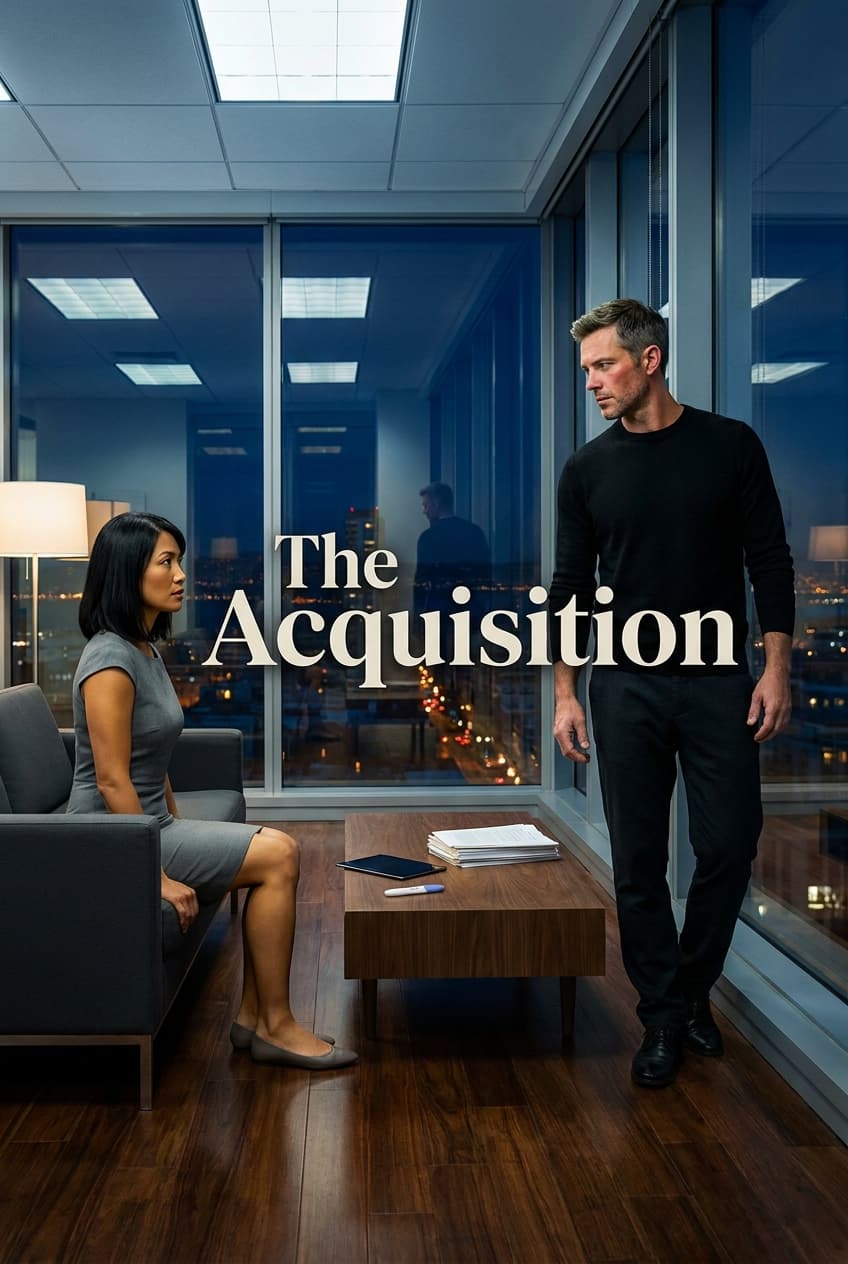
The penthouse feels smaller after Marcus leaves.
Not physically—it's still obscenely vast, all floor-to-ceiling windows and minimalist furniture that costs more than most people's homes. But emotionally? Spiritually? Whatever part of me that used to feel safe in spaces has contracted to something the size of a fist.
I'm curled into the corner of his white leather sofa, nursing a glass of wine that's gone warm in my hands, replaying the last hour like it's a financial statement I can't quite balance.
Marcus had been different tonight. Softer, maybe. Or perhaps I'd just finally let myself notice.
We were talking about the acquisition—the Henderson merger, which should have been straightforward. Numbers, projections, the kind of conversation that usually makes my pulse race in the good way. But somewhere between the second glass of wine and the way his hand had lingered on my arm when he leaned in to show me something on his tablet, the conversation had shifted.
"You ever think about what happens after?" he'd asked, his voice doing that thing it does when he's being genuine—losing the performative edge, becoming almost rough with honesty.
"After what?" I'd known exactly what he meant.
"After the empire. After you've won." He'd stood then, moving to the window, and I'd watched him silhouetted against the city lights like he was made of them. "What's left when there's nothing else to conquer?"
I should have deflected. Made a joke. Offered some sardonic observation about how winning is usually enough for people like us. But something in his tone—a rawness I'd never heard before—had made me stay quiet.
"There was someone," he'd continued, and my stomach had done this awful, sickening flip. "Before all this. Before I made my first billion, before I could give her everything she could possibly want."
He hadn't looked at me when he said it. Just kept staring at the city like it held answers.
"She was brilliant," he'd said. "Artist. Not the kind who cares about money—the kind who actively resents it. We met at university, back when I was just some kid with a trust fund and delusions of being different from my family." A laugh that wasn't really a laugh. "I was going to prove that I wasn't defined by my bank account. That I could love someone who didn't need anything from me except myself."
I'd known where this was going. Could feel the tragedy in the shape of his shoulders.
"I built everything for her," he'd whispered. "Every deal I closed, every company I acquired—it was supposed to be proof that I could be more than just a rich kid. That I could be someone worth choosing." He'd finally turned to look at me, and his eyes had been gutted. "But success isn't attractive to people who want you to fail with them. She couldn't handle watching me become this. Couldn't handle that I wanted more than to be poor together."
The wine in my glass had suddenly tasted like ashes.
"She left when I was at my peak," he'd continued. "Right when I should have been happiest. Said I'd become exactly what I'd always feared—someone who mistakes accumulation for meaning. Someone who thinks he can buy his way into belonging."
I'd wanted to touch him. Had actually moved toward him before catching myself.
"She was right," he'd said, and there had been something in his voice that sounded like drowning. "I do that. I see something I want and I acquire it. I acquire people." He'd paused, and when he looked at me, there was a question in his eyes. A terrible, vulnerable question. "But what if I'm finally ready to stop acquiring and start choosing? What if I'm finally ready to be chosen back?"
The implication had hung between us like a loaded gun.
I'd stood up then, needing distance, needing air, needing to not be in a room where Marcus Chen was looking at me like I was the answer to a question he'd been asking his whole life. Because that's what his expression said. Not "I want you." But "You're the only person who understands what it costs to survive in a world that rewards ruthlessness."
"Marcus—" I'd started, but he'd held up a hand.
"I'm not asking for anything," he'd said, which was a lie. He was asking for everything. "I just needed you to know that I see you. The real you, not the armor. And I'm not going anywhere."
Then he'd left, because Marcus is smart enough to know that sometimes the most powerful thing you can do is give someone space to choose you.
Now, sitting alone in his penthouse with the city sprawling beneath me like a kingdom he's already conquered, I'm terrified that he's right.
I'm terrified that I'm going to choose him.
My phone buzzes. A text from an unknown number, which should alarm me but somehow doesn't.
*Julian: Are you at Chen's penthouse?
My breath catches. How does he—
Julian: Don't ask. I have people. Are you there?
Of course he has people. Of course he can track my location like I'm a stock he's monitoring. The possessiveness should be infuriating. Instead, it sends a thrill through my nervous system that I absolutely cannot examine too closely.
Me: Why does it matter?
Julian: Because I'm ten minutes away and I need to know if I'm about to walk into something I'll regret.
Me: That's not how that works.
Julian: Everything is how I make it work. Ten minutes.
He hangs up—actually hangs up, like this is the 1990s and we're conducting business like civilized people—and I'm left staring at my phone like it's a bomb with a countdown timer.
Except the countdown isn't external. It's internal. It's the sound of my carefully constructed walls cracking under the pressure of wanting two men who represent two different versions of hell.
I have exactly ten minutes to decide what I'm doing here. With Marcus. With Julian. With the version of myself that's slowly emerging from underneath the rubble of who I used to be.
I stand up, walk to the window, and stare at the city like Marcus was doing. Like answers live somewhere in the glittering sprawl of lights and ambition and people trying desperately to matter.
The problem is, they both make me feel like I matter.
Julian makes me feel like I matter because he's obsessed with acquiring me—but not in the way he acquires companies. There's something different in the way he looks at me. Something that suggests he's terrified I'll slip through his fingers. That underneath all that confidence is a boy who was never quite enough for his father, and he's desperate to be enough for someone.
Marcus makes me feel like I matter because he sees the cost of my survival and doesn't flinch from it. He gets it—the way success tastes like copper and ash. The way building an empire means leaving bodies in your wake, people who couldn't handle the altitude. He's offering me a partnership forged in mutual understanding rather than obsessive acquisition.
But here's the thing about mutual understanding: it can become mutual destruction just as easily.
The elevator chimes.
My heart does something that's not medically advisable.
Julian emerges from the private elevator like he owns it, because of course he does—he probably owns the entire building. He's still in his suit from earlier, though he's loosened his tie and rolled up his sleeves, and the casual disarray makes him look dangerous in a completely different way.
His eyes find me immediately.
"You're here," he says, and it's not a question. It's a statement of fact, delivered with the kind of certainty that suggests he's been running scenarios in his head for the past ten minutes and this is the outcome he calculated for.
"I'm here," I confirm, because apparently I've decided to stop being clever. "How did you—"
"I told you. I have people." He moves toward me with that predatory grace that makes my brain short-circuit. "The question is why you didn't tell me you were meeting with Chen."
"I don't report my movements to you."
"No," he agrees, stopping a few feet away—close enough that I can smell him. Bergamot and leather and that aged whiskey scent that's become as addictive as nicotine. "But you also don't usually hide them."
He's right, and I hate that he's right, and I hate more that he can read me this well.
"We were discussing business," I say, which is technically true and also the most transparent lie I've ever told.
"You were discussing business," Julian repeats, and there's something sharp in his voice now. Something that sounds like possession. "And he was discussing something else entirely."
"How would you—"
"Because I know him. I know what he looks like when he's decided someone is worth more than his empire." Julian finally closes the distance between us, and suddenly the penthouse feels impossibly small. "And I know what you look like when you're considering letting someone convince you that mutual trauma is the same as mutual love."
I step back. My legs hit the sofa.
"You don't know what I look like," I say, but my voice has gone breathless and traitorous.
"I know exactly what you look like." He reaches out, his fingers brushing a strand of hair that's escaped my bun. His touch is gentle, which somehow makes it worse. "You look like someone who's finally considering letting someone else carry half the weight. Someone who's terrified that if you stop being the only person you can rely on, you'll shatter."
"Don't—"
"I'm not him," Julian continues, and his hand moves to my cheek, cupping it with a tenderness that feels like a weapon. "I'm not going to offer you mutual destruction dressed up as understanding. I'm not going to make you feel safe by reminding you of how much it costs to survive. I'm going to make you feel like you don't have to survive anymore. Like you can actually live."
My eyes are burning. I hate that. I hate that he can make me feel things I've spent years learning not to feel.
"You're possessive," I say, trying to find solid ground. "You think you can buy everything you want."
"I am possessive," he agrees, and there's no apology in it. "But not of things. Of people I choose. And I'm choosing you, Evelyn. Not because I want to acquire you. Because I want to build something with you that doesn't require either of us to be smaller versions of ourselves."
"That's not how this works," I whisper, but I'm not pulling away from his touch.
"No," he says, and leans in closer. "This is how it works."
He kisses me like he's proving a point. Like he's demonstrating the difference between possession and protection, between acquisition and choice. His hand moves from my cheek to the back of my neck, pulling me closer, and I can taste the scotch he's been drinking and something underneath it that's just him.
My hands find his shoulders—I don't remember deciding to touch him, but suddenly I'm gripping his jacket like it's the only thing keeping me tethered to reality.
The kiss deepens. His other hand finds my waist, and the heat of it through my blouse is almost unbearable. I'm hyperaware of every point of contact: his mouth, his hands, the way he smells like expensive cologne and something else—something raw and real beneath the polish.
When he pulls back, I'm breathless.
"That," he says softly, "is the difference between what he's offering and what I'm offering."
I want to argue. Want to tell him that Marcus's vulnerability is its own kind of seduction, that his brokenness mirrors mine in ways that feel like recognition. But my body is still thrumming with the aftermath of his kiss, and my brain has apparently abandoned me in favor of my nervous system.
"This is complicated," I say instead.
"Everything worth having is complicated." He brushes his thumb across my lower lip, and I have to fight the urge to lean into the touch. "But I'm not going anywhere. I'm going to wait for you to figure out that you don't have to choose between safety and passion. That you can have both if you're willing to trust someone."
"I don't trust easily."
"I know." He steps back, and I feel the loss of his warmth like a physical ache. "That's why I'm going to spend however long it takes proving that I'm worth trusting."
He leaves before I can respond, moving toward the elevator with the same casual confidence he brought in, and I'm left standing in Marcus's penthouse, tasting another man's kiss, feeling like I've just made a decision that's going to cost me everything.
My phone buzzes again.
Marcus: Everything okay?*
I don't respond. Can't. Because I'm not sure anymore what okay looks like, or if I'm capable of achieving it when I'm caught between two men who represent the two things I'm most terrified of: vulnerability and control.
The city glitters below me, indifferent to my crisis.
And somewhere in the darkness between the two penthouse towers, Julian Ashford is probably already calculating his next move.