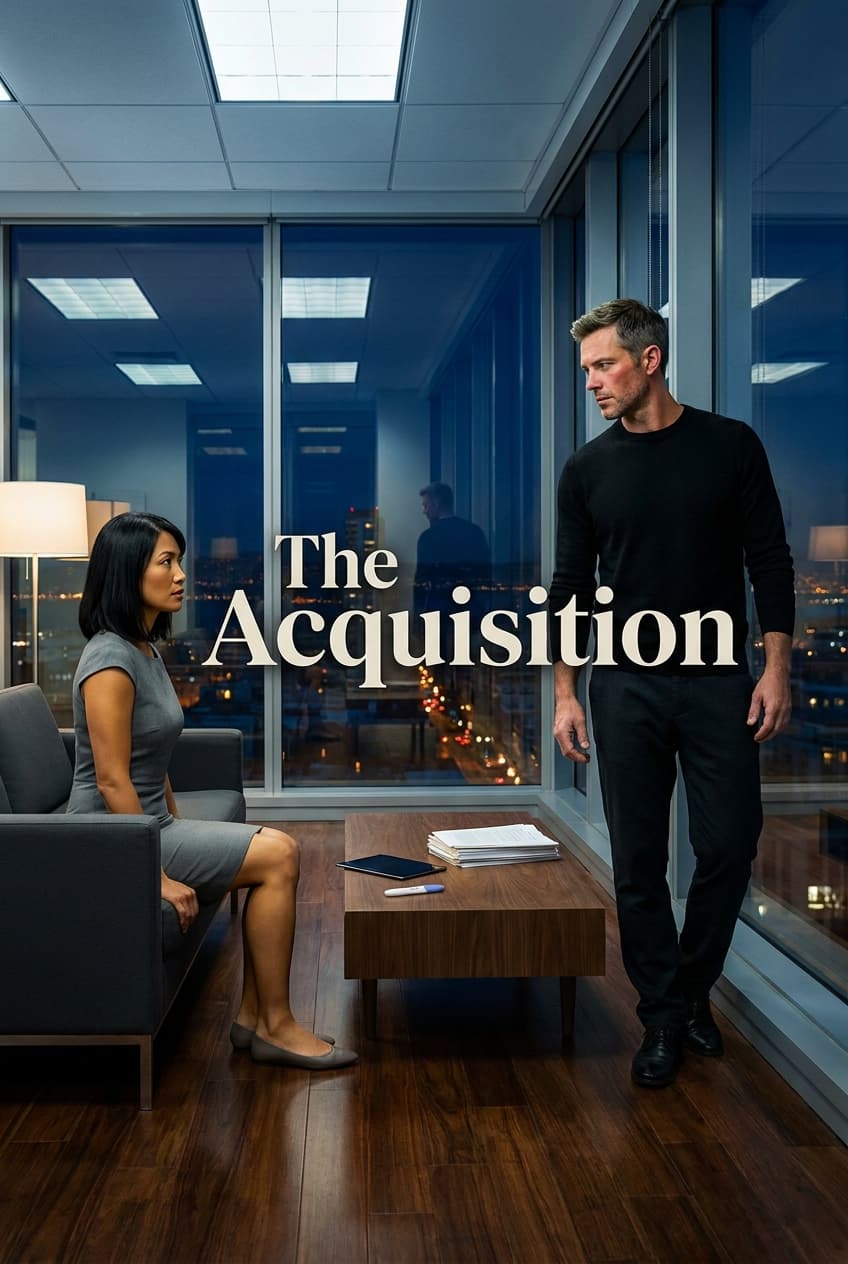
The conference room on the forty-second floor of the Ashford Building is designed to intimidate.
Floor-to-ceiling windows overlook Manhattan like we're gods surveying our kingdom. The table is mahogany the color of dried blood, polished to a mirror shine that reflects nothing but power. Thirteen chairs, though only three will be occupied. Symbolic, probably. Dominic's favorite kind of theater.
I arrive exactly on time—never early, never late. Punctuality is its own kind of power play; it says I'm not eager, not desperate, not the kind of woman who scrambles. My dress is armor today: a charcoal Armani suit with a white silk blouse that buttons to my throat. The scar on my collarbone stays hidden. I've learned that showing vulnerability, even accidentally, gives people ammunition.
Julian is already there.
He's standing at the windows, silhouetted against the city, and for a moment I just... look. Steel-gray eyes that catch the light like they're calculating the exact distance between us. Dark hair that looks like he ran his hands through it one too many times, which means he's nervous. Julian Ashford doesn't do nervous.
The scent hits me before anything else: bergamot and leather and that aged whiskey undertone that clings to him like a second skin. My body recognizes it before my brain catches up, and suddenly I'm hyperaware of my own breathing. Shallow. Controlled. Lying.
"Evelyn," he says, turning. Not a greeting. A statement. Like he's confirming my existence.
"Ashford." I move to the table and pull out a chair positioned to see both doors. Never sit with your back to an exit. Rule number one of survival. "Your father keeping us waiting?"
"Probably." Julian's mouth curves into something that isn't quite a smile. "He likes to make an entrance. Keeps everyone off-balance."
"I don't get off-balance."
"No," he agrees, and there's something in his voice that sounds like respect. Or hunger. With Julian, it's always hard to tell the difference. "You don't."
The air between us thickens. I can feel the weight of his attention like a physical thing, pressing against my carefully maintained composure. My pulse picks up, and I hate myself for it. This is exactly the kind of distraction I can't afford today.
I open my portfolio instead, because looking at spreadsheets is safer than looking at him. The numbers don't want anything from me. They don't make my skin feel too tight or my breath come short.
"The Meridian opportunity," I say, keeping my voice level. "You've reviewed the preliminary analysis?"
Julian moves closer—too close, but not close enough that I can call him out for it. He's learned how to operate in the space between appropriate and invasive. "Fifty-billion-dollar market disruption in sustainable infrastructure. You want to position us as the primary infrastructure partner for the Southeast corridor development."
"I want to position us as the only logical choice," I correct. "Meridian needs credibility and capital. We have both. The question is whether we have the stomach for a three-to-five-year play with minimal immediate returns."
"You do." It's not a question.
"I do," I confirm. "The question is whether your father does."
Julian's jaw tightens at the mention of Dominic, and I file that away. Leverage. Always useful to know where the fractures are in a man's foundation.
The doors open before he can respond.
Marcus enters like he's been waiting for the exact moment to make his arrival count. He's in designer streetwear that somehow manages to be more commanding than a suit—white tea and cedarwood washing over me like a storm, fresh and electric and alive. His dark eyes find me immediately, and there's a moment where the world narrows to just the two of us, and then he's smiling like he knows exactly what I was thinking about.
He doesn't. He can't. But the certainty in his expression makes my stomach flip anyway.
"Evelyn." He leans down to kiss my cheek—a greeting that's just barely professional—and I catch myself holding my breath. His hand finds the small of my back, fingers splaying across the silk of my blouse, and the contact burns through the fabric like he's touching bare skin. "You look like you're about to close someone's entire world."
"Only if they deserve it," I say, pulling away before I can do something stupid like lean into him. "Meridian's waiting on our preliminary response by end of week."
"Which is why we're here." Marcus settles into a chair, and his energy fills the room like electricity. This is what separates him from men like Julian—where Julian was born into power, Marcus had to build it, and he still moves like someone who's never forgotten what it felt like to have nothing. "Tell me why I should care about sustainable infrastructure when I could be disrupting something more profitable."
"Because you're not just about profit," I say quietly. "You never have been."
Something shifts in his expression. A recognition. An acknowledgment that I see him—not the billionaire persona, but the man underneath who still remembers his mother's apartment in Queens, who still feels something when he talks about communities that don't have clean water.
Julian watches this exchange like a man watching his own obsolescence.
"The market's already saturated with ESG plays," Marcus continues, but his tone has changed. It's softer. More open. "What makes this different?"
I pull up the holographic display, and the numbers bloom across the table in brilliant blue light. "Meridian's technology is proprietary. They've solved the scalability problem everyone else has been chasing for fifteen years. But they're a startup. They have the innovation and the vision, but they don't have the institutional trust to attract the capital they need for implementation."
"So they need us to be the adult in the room," Julian says.
"They need us to be the guarantee," I correct. "They need our names on the deal so that when they walk into a room with city planners and government officials, those people know the money is real and the commitment is binding."
"And in exchange?" Marcus leans forward, his attention razor-sharp. When he focuses, he focuses completely. It's one of the things that terrifies me about him—how thoroughly he can see you if you let him.
"Equity stake. Board positions. First right of refusal on all proprietary technology developments for the next decade." I pause, letting them absorb the scope of it. "And positioning ourselves as the architects of the next generation of American infrastructure."
"Which means we're betting on government," Dominic Ashford says from the doorway.
I didn't hear him enter. That's the first sign that I'm losing focus, and I hate myself for it immediately.
Dominic looks exactly like Julian will look in twenty-five years if the warmth never quite reaches his eyes. Silver-streaked dark hair, expensive tailoring that hangs on a frame that's beginning to show age. But where Julian carries his authority like it's a burden he's still learning to bear, Dominic wears his like a crown that's welded itself to his skull.
"We're betting on inevitability," I say, meeting his gaze without flinching. "Infrastructure investment is coming whether we participate or not. The question is whether we want to shape it or watch it happen."
Dominic moves to the head of the table—his table, in his building, in his world—and sits with the precision of a man who's never been uncertain about his right to occupy space.
"You're betting on inevitability," he repeats, and his voice is cold in a way that Julian's never quite manages. "Which is what people do when they've already lost. They bet on things they can't control and hope the universe cooperates."
The implication hangs in the air like smoke: You've already lost. You don't get to make decisions about inevitability.
"With respect," I say, and my voice is steady in a way that makes me proud, "I've built a career on making money from things I can't control. That's literally the definition of venture capitalism."
"You've built a career on being clever," Dominic counters. "Which is not the same thing as being wise. Clever people make mistakes because they're too busy proving they're smart to notice what they're destroying."
Julian tenses beside me. I can feel it in the way his breathing changes, the way his hand clenches into a fist on the table. He's about to defend me, which is both touching and incredibly stupid.
"The risk assessment is sound," Marcus says smoothly, cutting through the tension like a blade. "I've had my team run independent models. The infrastructure thesis holds up. More importantly, the team at Meridian is solid. I know the CEO. She's not a visionary without execution capability—she's someone who's been building toward this for years."
"Of course you do," Dominic says, and there's something almost pitying in his tone. "You always know people like that. It's what makes you useful."
The word lands like a slap. Useful. Not valuable. Not equal. Useful—the designation of a tool, something to be employed and discarded when it breaks.
Marcus doesn't react outwardly, but I see his jaw tighten. I see the way his fingers curl slightly, like he's physically holding back a response. I see the moment he decides that Dominic isn't worth the energy.
"The real question," I say, pulling attention back to the numbers, "is whether Ashford Capital wants to lead the round or participate. Leading gives us control of the narrative and board representation. Participating means we're along for the ride."
"Leading means we're publicly aligned with a bet on government policy," Dominic says. "Which means we're vulnerable if the political winds shift."
"Which is why we structure it as a diversified portfolio play," I counter. "We're not betting on one administration or one policy. We're betting on the fact that American cities need infrastructure investment regardless of who's in power. It's the one thing both parties actually agree on."
Dominic leans back in his chair, steepling his fingers. It's a gesture I've seen Julian make a hundred times—the Ashford tell, the moment when they're calculating whether you're worth their time.
"You're very confident for someone who has so much to lose," he says quietly.
The words hit something deep. Something that remembers being confident and wrong. Something that remembers losing everything and having to rebuild from ash.
I meet his gaze and don't look away.
"I'm very confident because I've already lost everything that matters," I say, and my voice doesn't shake. "I lost it years ago, and I survived. Losing money after that is just logistics."
Julian's head turns toward me. I can feel his attention like a physical force, but I keep my eyes on Dominic.
"So when you sit across from me and tell me that a deal is worth the risk, you're not bluffing," Dominic continues. "You actually believe it. Which means either you're a true believer—which I don't trust—or you've already calculated what happens if you're wrong and decided you can live with it."
"I can always live with being wrong," I say. "What I can't live with is not trying."
For a moment, nobody speaks. The city hums beneath us, indifferent to our machinations, and I wonder if this is what it feels like to stand at a crossroads and not know which path leads home.
"I want to see the full financial model," Dominic says finally. "Not the presentation version. The actual model. Every assumption, every variable, every place where you're making a bet instead of a calculation."
"You'll have it by tomorrow," I promise.
"I'll have it by end of business today," he corrects. "If you're serious about this."
He stands, and the meeting is over. Just like that. Dominic Ashford has made his decision about whether to engage, and the rest of us are just waiting to see what it is.
Julian walks me to the elevator, leaving Marcus to discuss some technical detail with his father. The hallway is empty—all marble and expensive art and the kind of silence that only exists in buildings where people are too important to make noise.
"That was—" Julian starts.
"Brutal?" I offer. "Calculated? A masterclass in psychological warfare disguised as business discussion?"
"I was going to say impressive," he says quietly. "But yeah. All of that too."
The elevator arrives with a soft chime, and I step inside. Julian follows, which is against every protocol I've established for maintaining professional boundaries. The doors close, and suddenly we're suspended between floors, between worlds, between what's appropriate and what's inevitable.
"Your father hates me," I say.
"My father doesn't hate anyone," Julian corrects. "He just evaluates people based on utility and risk. You're high-risk in his calculus because you can't be controlled through traditional means."
"And that bothers him."
"It bothers him that it doesn't bother me," Julian says, and there's something in his voice that sounds like a confession.
The elevator continues its descent, and he moves closer. Not threatening. Just... closer. The scent of bergamot and leather wraps around me like a cage I'm choosing to stay in.
"You could have defended me back there," I say. "You didn't."
"You didn't need me to." His hand reaches out, and for a moment I think he's going to touch me. Instead, he just lets his fingers hover near my cheek, in the space between wanting and having. "You needed me to trust that you could handle it. So I did."
My breath catches. Literally catches in my throat like I'm a teenager with a crush, not a woman who's built an empire on emotional discipline.
"That's not going to work," I whisper.
"What isn't?"
"This." I gesture between us, though it's not really between us—it's inside me, burning through my carefully constructed walls. "Whatever this is. It's not going to work because I can't—I don't—"
"I know," he says, and his hand finally touches my face. Just his thumb, tracing the line of my cheekbone with devastating gentleness. "I know you don't do this. But that doesn't mean I'm going to stop wanting you to."
The elevator reaches the lobby, and the doors slide open.
I step out without looking back, because if I look back, if I see him standing there with that expression like I'm something worth fighting for, I might actually believe it.
And believing things is how you get destroyed.
My phone buzzes as I'm walking through the lobby. A text from Marcus: Drinks tonight? I want to talk about what just happened in that room. And not the business part.
I don't respond. I can't. Because if I do, if I let myself have one more moment of connection with either of these men, I'm going to forget why I built these walls in the first place.
The thing about armor is that it works both ways.
It keeps people out.
But it also keeps you in.