The mask was ridiculous.
I stared at my reflection in the polished bronze mirror, hardly recognizing myself. The papyrus and linen construction covered the upper half of my face, painted in the likeness of Bastet—the cat goddess, all kohl-lined eyes and delicate whiskers. My practical braids had been unwound, dark hair falling loose around my shoulders in a way that made me look younger. Softer.
Dangerous.
"I look absurd," I muttered.
"You look Egyptian." Neferet circled me like a predator evaluating prey, adjusting the drape of the simple linen dress she'd insisted I wear. No foreign robes tonight. Nothing that would mark me as other. "Which is rather the point."
The Festival of Opet had transformed Thebes into something from a fever dream. For three days, the boundaries that normally kept society rigidly stratified dissolved like salt in the Nile. Nobles walked among farmers. Slaves wore flowers in their hair. And everyone—everyone—hid behind masks.
It was supposed to celebrate the sacred marriage between Amun and Mut, the journey of the god's barque from Karnak to Luxor. But what it really celebrated was chaos. Beautiful, drunken, liberating chaos.
"I still don't understand why—"
"Because he commanded it." Neferet's smile was knowing, infuriating. "My brother rarely indulges in anything resembling pleasure. If he wants to play commoner for an evening, who am I to deny him?"
"He could play commoner with anyone."
"But he asked for you."
The words sent something warm and treacherous spiraling through my chest. I crushed it ruthlessly.
"To discuss strategy," I said. "Ptahmose's network, the information he wants me to feed—"
"Of course." Neferet's tone suggested she believed that about as much as I did. "Strategy. In the middle of the largest festival of the year. How wonderfully practical."
She handed me a second mask—simpler, masculine, painted to resemble a jackal. Anubis, guide of the dead.
How fitting for a Pharaoh who'd learned to navigate the underworld of court politics before he'd finished growing into his father's crown.
"He'll meet you at the Temple of Mut's western gate," Neferet said. "Try not to get him killed. I've grown rather attached to having a brother."
---
The streets of Thebes had become a river of bodies and noise.
Music poured from every corner—the hypnotic pulse of drums, the wail of reed flutes, voices raised in songs both sacred and decidedly not. The air was thick with smoke from a thousand oil lamps, heavy with the scent of lotus blossoms and roasting meat and palm wine. So much palm wine.
I pushed through the crowds, my heart beating too fast. This was madness. The Pharaoh of Egypt, slipping away from his guards to walk among his people like some character from a children's tale. And I was enabling it.
Worse—I was excited about it.
The western gate of the Temple of Mut loomed ahead, its massive pylons dark against the star-scattered sky. Torches blazed along the walls, casting dancing shadows across the faces of revelers who'd spilled out from the inner courtyards.
I almost missed him.
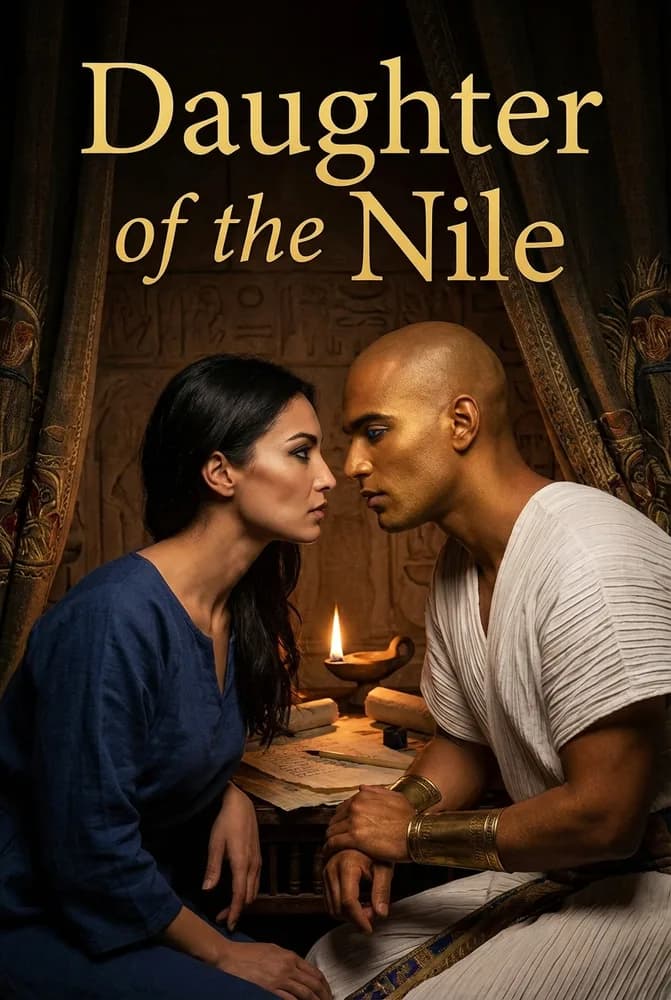
He stood in the shadows between two columns, and if I hadn't been looking for the jackal mask, I would have walked right past. Gone was the elaborate regalia, the gold and lapis that announced his divinity. Instead he wore a simple white kilt and a plain linen shirt that left his arms bare. His feet were sandaled like any farmer's. The mask covered enough of his face that he could have been anyone.
Except for the way he held himself. That unconscious authority that clung to him like the scent of myrrh and cedar.
Gods, even disguised as a commoner, he looked like a king.
"You came." His voice was low, pleased.
"You commanded it."
"I asked." He stepped closer, and I caught the familiar spice of blue lotus oil, fainter now but still there. Still him. "There's a difference."
"Is there? When a Pharaoh asks?"
"Tonight there is." He gestured to the chaos around us, the masks and music and beautiful disorder. "Tonight I'm not a Pharaoh. Just a man who wanted to see his city without a thousand guards watching his every breath."
"And I'm what? Your guide to the common experience?"
"You're the only person in my court who doesn't want something from me."
The laugh escaped before I could stop it—sharp and bitter. "Everyone wants something from you. I'm just more honest about it."
"Exactly." He tilted his head, studying me through the jackal mask's eye-holes. "You want to survive. It's refreshingly simple."
If only he knew how complicated it had become.
He offered his hand. "Come. Let me show you my city."
I shouldn't have taken it. Should have maintained the distance, the careful walls between spy and target, between foreign scholar and divine king.
But his palm was warm against mine, callused in unexpected places—from weapons training, I realized. From the hours he spent in the practice yards, keeping himself sharp.
Keeping himself alive.
I let him lead me into the river of masks and music.
---
We moved through the festival like ghosts, invisible in our anonymity.
No one bowed. No one prostrated themselves or averted their eyes. We were just two more revelers among thousands, swept along by the current of celebration. Khemweset's hand stayed wrapped around mine, an anchor in the chaos.
The sacred barques were being carried through the streets in a procession of priests and dancers, the gilded boats of Amun and Mut swaying above the crowds like ships on a human sea. Incense billowed in clouds so thick I could taste it—frankincense and myrrh and something sweeter, probably kyphi. The scent mixed with sweat and perfume and the yeasty smell of beer being distributed from massive clay vessels.
"They say the gods walk among us during Opet," Khemweset said, his voice close to my ear so I could hear him over the drums. "That Amun renews his divine power through union with his consort."
"Convenient theology. Gives everyone an excuse to get drunk and fuck."
I felt his laugh more than heard it, a vibration that traveled through our joined hands. "You have such a romantic view of religion."
"I've read too many sacred texts to be romantic about anything."
We'd reached the river's edge where the crowds thinned slightly. The Nile stretched before us, black and silver under the stars, its surface reflecting the torches that lined the banks. Boats drifted past, filled with celebrating families. Music drifted across the water, haunting and strange.
Khemweset released my hand—I tried not to notice the loss—and leaned against one of the mooring posts. Even in profile, masked and disguised, he was beautiful. The kind of beautiful that was dangerous to notice.
"Do you believe in fate?" he asked suddenly.
"That's a heavy question for a festival."
"Humor me."
I considered. The wine I'd accepted from a passing vendor was making my thoughts pleasantly fuzzy at the edges, loosening the careful control I usually maintained.
"No," I said finally. "Fate is what people call it when they don't want to take responsibility for their choices. We make decisions. We live with the consequences."
"So you chose to be a spy."
"I chose to survive." The words came out sharper than intended. "Rhodes was burning. My family was dead. A Greek general offered me gold to use my languages against Egypt. I chose to eat instead of starve. If that's fate, it's a cruel bitch."
He was quiet for a long moment, watching the river. When he spoke, his voice was soft. "My father died when I was nineteen. Poison in his wine. They said it was an accident—bad grapes, fermentation gone wrong. But I knew." His hands tightened on the mooring post. "Ptahmose had been whispering in his ear for years, pushing him toward decisions that weakened the throne and strengthened the temples. When my father finally started to resist..."
"You couldn't prove it."
"No. And even if I could, the High Priest of Ptah is untouchable. The people believe he speaks for the gods themselves." His laugh was bitter. "So I smiled and accepted my crown and spent the last ten years learning to play the game better than the man who murdered my father. You call it choice. I call it survival. Maybe we're not so different."
The vulnerability in his voice made my chest ache. This was the man beneath the crown—the boy who'd lost his father and learned to trust no one. The king who carried the weight of a nation and pretended it didn't crush him.
I wanted to touch him. To offer comfort the way he'd offered his hand earlier.
Instead I said, "At least you look good in a mask."
He turned, and even through the painted jackal face I could feel the intensity of his gaze. "So do you."
The air between us shifted, charged with something that had nothing to do with the festival chaos around us.
"Dance with me," he said.
"I don't know Egyptian dances."
"Then I'll teach you."
He pulled me back into the crowds before I could protest, finding a space where musicians had gathered near a wine vendor's stall. The rhythm was hypnotic—drums and sistrums and the clap of hands. Bodies moved together in patterns both sacred and sensual, hips swaying, arms raised to the stars.
Khemweset's hands found my waist, positioning me. "Follow my lead."
"Bossy even when you're not being Pharaoh."
"Old habits."
He moved and I followed, stumbling at first, then finding the rhythm. His body was warm against mine, close enough that I could feel the heat radiating from his skin. The scent of cedar and myrrh wrapped around me, familiar now. Intoxicating.
We spun through the crowd, laughing when I stepped on his feet, when he had to catch me before I collided with a particularly enthusiastic drummer. The wine and music and his hands on my waist blurred together into something bright and reckless.
For a few stolen moments, we weren't spy and king. We were just two people dancing under the stars, anonymous and free.
"You're smiling," he said, his breath warm against my temple.
"Don't get used to it."
"Too late."
The song shifted, slowing into something deeper, more intimate. The crowds around us paired off, bodies pressing close in a dance that was definitely more secular than sacred. Khemweset's arms tightened around my waist, pulling me flush against him.
I could feel his heartbeat. Or maybe that was mine. Impossible to tell where I ended and he began.
"Kallista." My name in his voice was a prayer and a curse. "We should—"
"I know."
But neither of us moved.
The music swelled, and he spun me one final time before the song ended. We stood there, breathing hard, his hands still on my waist, my palms flat against his chest.
"Come with me," he said roughly. "I want to show you something."
---
The Temple of Mut's inner sanctum was forbidden to all but the highest priests.
Naturally, that's where Khemweset led me.
We slipped through a side entrance, past guards who were either bribed or simply too drunk on festival wine to care. The noise of the celebration faded as we moved deeper into the temple complex, replaced by the whisper of our sandals on stone and the distant echo of chanting from some inner chamber.
"If we're caught—" I started.
"We won't be."
"You're very confident for someone committing sacrilege."
"I'm Pharaoh. It's not sacrilege if I do it."
Despite everything, I smiled. "That's not how religion works."
"That's exactly how religion works when you're considered a living god."
He led me through a maze of corridors, clearly knowing the temple's layout by heart. We passed walls covered in hieroglyphs that glowed in the lamplight, scenes of creation and destruction, birth and death, the eternal cycle.
Finally we emerged into a small courtyard open to the sky. A pool of sacred water reflected the stars, and the air smelled of lotus blossoms and something else—old stone and incense and time itself.
"I used to hide here," Khemweset said quietly, removing his mask. "When court became too much. When I needed to remember who I was before the crown."
I pulled off my own mask, suddenly breathless. "And who are you?"
"I'm still trying to figure that out."
He moved to the pool's edge, staring down at his reflection. Without the mask, his face was exposed—beautiful and terrible and utterly human. The face of a man carrying impossible weight.
I went to him because I couldn't not.
"Khemweset—"
He turned, and suddenly we were too close. His eyes were black in the starlight, fathomless. I could see my reflection in them, small and uncertain.
"I shouldn't have brought you here," he said, but he didn't move away.
"No. You shouldn't have."
"This is a mistake."
"Probably."
His hand came up, fingers tracing the line of my jaw with devastating gentleness. "You're going to ruin me."
"You're already ruined. I'm just bearing witness."
The laugh that escaped him was broken, raw. "Gods, you see too much."
"It's what you pay me for."
"I don't pay you for this." His thumb brushed across my lower lip, and my breath caught. "For making me feel human again. For reminding me what it's like to want something I can't have."
"Who says you can't have it?"
The words escaped before wisdom could stop them. His eyes darkened, pupils swallowing the obsidian iris. The hand on my jaw tightened, and he leaned closer, close enough that I could count his eyelashes, close enough to taste the palm wine on his breath.
"This can't be real," he whispered against my mouth. "Nothing between us can be real."
"Then let it be fake." My hands fisted in his shirt, pulling him closer. "Let it be a lie we tell ourselves for one night."
For a heartbeat, I thought he'd close the distance. Thought he'd kiss me and damn the consequences, damn the politics and the danger and the thousand reasons this was impossible.
His lips brushed mine, barely a touch, more promise than kiss.
Then he jerked back like I'd burned him.
The loss was physical, a cold rush of air where his warmth had been. He staggered backward, his expression shuttering, walls slamming into place so fast I could hear them lock.
"This was a mistake." His voice was flat, emotionless. The Pharaoh's voice, not the man's. "I shouldn't have—we can't—"
"Khemweset—"
"You should go." He wouldn't look at me. "Return to your quarters. We'll speak tomorrow about Ptahmose's intelligence network."
Just like that, we were back to spy and king. Back to the roles that kept us safe and separate and alone.
I wanted to argue. To grab him and shake him and demand he stop hiding behind his crown. But the set of his shoulders, the careful distance he'd put between us—it was clear as any words.
He was terrified.
Not of Ptahmose or political intrigue or even assassination. But of this. Of what we could be if we were brave enough to reach for it.
And maybe I was terrified too.
I retrieved my mask from where I'd dropped it, the papyrus suddenly heavy in my hands. "As you command, Great One."
The title was a knife between us, deliberate and cruel.
His jaw tightened, but he said nothing.
I left him there beside the sacred pool, alone with his reflection and his fear and the ghost of an almost-kiss.
---
The walk back to my quarters was a blur of noise and color and emptiness.
The festival still raged around me, but I moved through it like a shade, untouched by the joy. My lips still tingled where his had barely brushed them. My skin still remembered the heat of his hands.
I was falling.
I'd known it before, but this was different. This was the moment I realized I'd already fallen, that there was no climbing back up to safety, no way to unfeel what I felt.
I'd fallen for a Pharaoh who couldn't afford to fall back.
For a man so isolated by power that even a moment of genuine connection terrified him more than poison or plots or the High Priest who'd murdered his father.
And the worst part—the truly devastating part—was that I understood. Because I was just as afraid. Just as convinced that anything real between us would end in ruin.
We were two people who'd learned to survive by trusting no one, and now we'd found someone worth trusting at exactly the wrong moment, in exactly the wrong circumstances.
I reached my quarters and collapsed on the bed, still wearing the ridiculous dress, the mask clutched in my hands.
Tomorrow the Persian letter would arrive and everything would shift again. Tomorrow I'd have to prove my worth by analyzing intelligence that could save or doom Egypt. Tomorrow I'd have to be the spy, the scholar, the useful tool.
But tonight, alone in the darkness, I let myself feel it. The wanting. The loss. The terrible, beautiful ache of almost.
I pressed my fingers to my lips, remembering the ghost of his kiss.
And I wondered if he was doing the same.