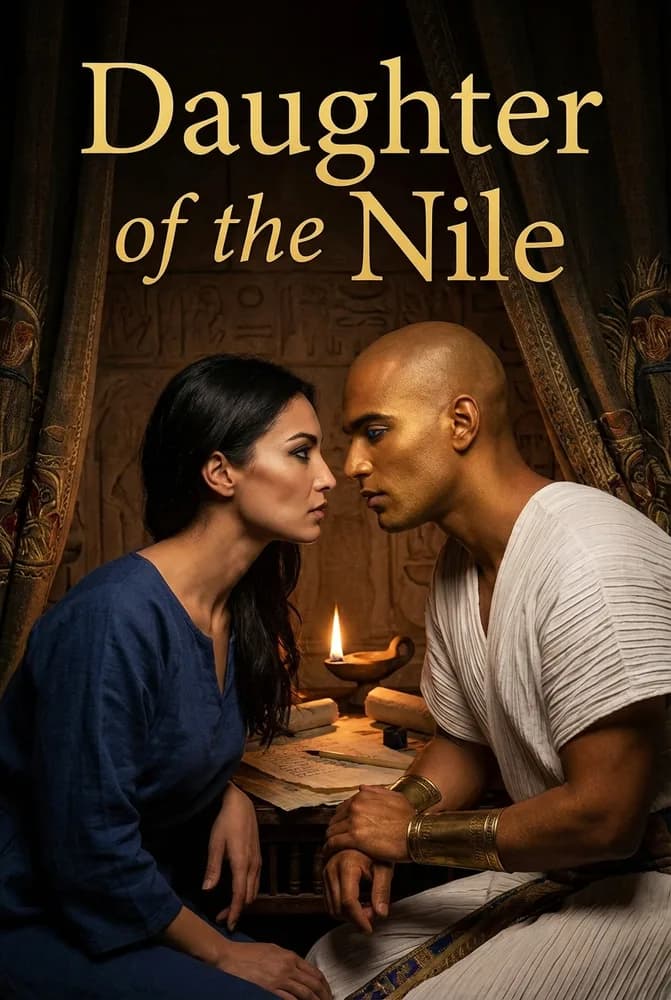
I woke to pounding on my door and the grey light of false dawn.
Not the gentle wake-up call of a servant. This was urgent, aggressive—the kind of knock that meant something had gone catastrophically wrong.
I stumbled from bed, still wearing yesterday's ridiculous festival dress, and yanked open the door.
One of Khemweset's guards stood there, his face carefully blank in that way that meant he was trying very hard not to stare at the foreign woman who'd clearly slept in her clothes.
"The Pharaoh requires your presence in the council chamber. Immediately."
My stomach dropped. "What's happened?"
"A messenger arrived from the eastern border an hour ago." His jaw tightened. "Persia."
Fuck.
I was supposed to have had more time. The intelligence I'd been waiting for, the crisis that would prove my worth—it had arrived early, catching me unprepared and half-drunk from last night's wine.
Last night's almost-kiss.
I shoved the thought away. No time for that particular complication now.
"Give me five minutes."
I didn't waste them on vanity. Stripped off the festival dress, threw on the simplest tunic I owned, wound my braids into their practical knot. Splashed water on my face to clear the fog of interrupted sleep and too much palm wine.
My hands were shaking.
This was it. The moment when I'd either prove myself indispensable or reveal myself as a fraud. When Khemweset would discover whether his pet scholar was worth the risk of keeping her close.
I pressed my palms flat against the cool stone of my washbasin and took a breath.
Then another.
I'd survived Rhodes falling. I'd survived selling my skills to men who saw me as a useful tool and nothing more. I'd survived two months in this golden cage, dancing between languages and loyalties.
I could survive this.
I had to.
The guard was waiting when I emerged, his expression unchanged. He led me through corridors just beginning to wake, past servants lighting lamps and priests performing dawn rituals. The palace felt different in this liminal hour—less like a seat of power and more like a living thing taking its first breath of the day.
We reached the council chamber to find it already in chaos.
Voices raised in argument. The sharp gestures of men who'd been roused from sleep and weren't pleased about it. The acrid smell of fear disguised as righteous anger.
And at the center of it all, Khemweset.
He stood at the head of the long table, still wearing what looked like the same clothes from last night, his mask discarded but his face just as carefully blank. The only sign of tension was in his hands, braced against the table's edge, knuckles white with pressure.
His eyes found mine across the room.
Something passed between us—acknowledgment, maybe, or warning. A reminder that whatever had almost happened in that temple alcove was irrelevant now. We were back in the world of crowns and consequences.
"Finally." Ptahmose's voice cut through the din. The High Priest stood to Khemweset's right, resplendent in his leopard skin even at this ungodly hour. "The Pharaoh's... consultant arrives."
The pause before 'consultant' was deliberate. A reminder that I was foreign, female, fundamentally other.
I ignored him and focused on Khemweset. "You sent for me, Divine One."
"A messenger arrived from the eastern garrison at Memphis." His voice was perfectly controlled, giving nothing away. "Correspondence was intercepted—Persian correspondence, discussing troop movements along our border."
He gestured to the table.
A scroll lay there, the seal already broken. Even from here I could see the distinctive script, the quality of the papyrus. Persian work, no question.
My pulse kicked up. This was real intelligence, not the manufactured crisis I'd been expecting.
"The High Priest believes we should respond with prayer and defensive fortifications," Khemweset continued, his tone utterly neutral. "My generals want to mobilize immediately. I want to know if the threat is genuine before I commit Egypt's resources to either course."
"Prayer is always appropriate when facing the enemies of Ma'at," Ptahmose interjected smoothly. "The gods will protect Egypt as they always have. Hasty military action based on potentially false intelligence could provoke the very war we seek to avoid."
I moved closer to the table, aware of every eye tracking my progress. The council members—mostly men twice my age, draped in the symbols of their authority—watched with expressions ranging from skepticism to outright hostility.
Only one face showed something different.
Neferet stood near the window, wrapped in a robe of deep blue linen, her kohl slightly smudged from interrupted sleep. She studied me with those dark, calculating eyes, her expression unreadable.
I reached the table and picked up the scroll.
The papyrus was expensive, well-made. The script was confident, flowing—someone educated, someone important. I scanned the contents quickly, my mind automatically translating from Persian to Greek to Egyptian.
Honored General Artaxias,
The eastern approaches remain as you described—poorly fortified and vulnerable during the inundation season when Egypt's attention turns inward. Our lord believes the time approaches for action...
"Well?" Ptahmose's voice held an edge. "Can you verify its authenticity, or shall we rely on the wisdom of those who actually understand Egyptian interests?"
I didn't look up. "Give me a moment. Verification requires more than a glance."
"We don't have moments," one of the generals snapped. "If the Persians are moving—"
"Then they've been planning this for months, and five more minutes won't matter." I kept my tone level, professional. "Unless you'd prefer I guess?"
Silence.
I examined the scroll more carefully, looking for the telltale signs of forgery. The ink quality, the papyrus grain, the way certain letters formed. Persian script had regional variations—a scribe from Persepolis wrote differently than one from Babylon, subtle differences in letter height and spacing that most people would never notice.
But I noticed everything.
That was what had kept me alive.
I checked the seal impression, still visible in the broken wax. Official, or at least a very good copy. The correct symbols for a military correspondence, the right quality of wax.
Then I read it again, this time paying attention to the language itself. The formal structure, the way information was conveyed. Persians had specific protocols for military communication, patterns that were difficult to fake if you didn't understand the culture behind them.
My stomach tightened.
"It's genuine," I said quietly.
The room erupted.
"You can't possibly be certain—"
"Based on what authority—"
"A foreign woman's opinion is hardly—"
"Enough." Khemweset's voice cut through the chaos like a blade. "Explain your reasoning."
I met his eyes. They were unreadable, black as obsidian and just as hard. But he was listening. Actually listening, not just performing the motions of consultation.
"The papyrus quality matches known Persian military supplies—you can see the distinctive reed marks here." I pointed to the edge. "The seal is correct for General Artaxias, who we know commands the eastern satrapies. The language patterns are authentic, including this phrase—" I indicated a line, "—which is a formal military courtesy that wouldn't appear in a forgery unless the forger had extensive knowledge of Persian protocols."
"Anyone could learn those protocols," Ptahmose observed. "If they wanted to create convincing false intelligence."
"True. But look at this." I traced another section. "The scribe who wrote this has a distinctive formation on the letter shin—slightly elongated, with a particular curl at the base. I've seen this same formation in other documents from the eastern satrapies. It's an individual variation, the kind of thing that's nearly impossible to fake consistently."
I looked up, meeting the council's skeptical stares.
"This is genuine correspondence from a Persian general discussing invasion plans. The question isn't whether the threat is real—it is. The question is whether this letter was meant to be intercepted."
That stopped them.
Khemweset leaned forward slightly. "Explain."
"If I were planning an invasion and wanted to ensure my enemy was caught unprepared, I might send false intelligence suggesting I was coming from the east when I actually planned to attack from the north. Let them mobilize their forces in the wrong place." I set the scroll down carefully. "But if I wanted my enemy to waste resources preparing for an attack that wasn't coming yet, I might let them intercept genuine correspondence about preliminary discussions. Make them mobilize too early, exhaust their troops and treasury, then attack when they've stood down."
The room had gone very quiet.
"So which is it?" Neferet's voice was cool, measured. "Genuine threat or genuine misdirection?"
I studied the scroll again, reading between the lines. Looking for what wasn't said as much as what was.
"Genuine threat," I said finally. "The language is too specific about defensive weaknesses. If this were meant to be intercepted as misdirection, it would be vaguer, more obviously bait. This reads like actual strategic assessment. Whoever wrote this didn't expect it to be intercepted—which means someone on the Persian side wanted us to see it."
"A traitor?" one of the generals asked.
"Or someone who thinks Egypt falling to Persia would be bad for everyone, including Persia." I shrugged. "Either way, the threat is real. The question is timing."
Khemweset's fingers drummed once against the table. "Your assessment of timing?"
I scanned the letter again, looking for temporal markers. "They mention the inundation season—which is months away. This is preliminary planning, not imminent action. But that doesn't mean we have unlimited time. If they're discussing it now, they could move within the year."
"Then we mobilize," the general said immediately.
"No." Khemweset's voice was flat, absolute. "We prepare quietly. Reinforce the eastern garrisons without fanfare. Send scouts to verify troop movements. If the Persians think we're unaware, they'll continue planning openly. The moment they know we know, everything goes dark."
He looked at Ptahmose. "And yes, we pray. The gods' favor is always welcome. But we also sharpen our swords."
The High Priest's expression was carefully neutral, but I saw the flash of irritation in his amber eyes. He'd been outmaneuvered, his attempt to position himself as the voice of divine wisdom dismissed in favor of pragmatic strategy.
And Khemweset had done it based on my analysis.
"I want verification," Khemweset continued. "Send riders to the eastern border. I want reports on Persian troop movements, supply lines, anything that confirms or contradicts this intelligence. And—" his eyes found mine again, "—I want every piece of Persian correspondence we've intercepted in the last year brought to the scholar. See if there are patterns we've missed."
My heart kicked against my ribs. He was giving me access to Egypt's intelligence archives. Trusting me with information that could be worth a fortune to the right buyer.
Trusting me.
"Divine One—" Ptahmose began.
"That's my decision." The words were soft but absolutely final. "This council is dismissed. We'll reconvene at sunset to discuss the scouts' assignments."
The council members filed out, some still muttering objections, others looking thoughtful. Ptahmose lingered, his gaze sliding between Khemweset and me, calculating something I couldn't quite read.
Then he too departed, leaving only Neferet.
And me.
And Khemweset, who looked like he hadn't slept in days.
"You should rest, brother," Neferet said quietly. "You've been awake all night."
"So have you."
"I'm not the one who has to lead an empire." She moved closer, her hand briefly touching his shoulder in a gesture of genuine affection. Then her eyes shifted to me. "Walk with me, scholar. I find I have questions about Persian linguistics."
It wasn't a request.
I followed her from the council chamber, aware of Khemweset's gaze tracking us until we disappeared into the corridor.
Neferet said nothing until we'd reached one of the smaller courtyards, this one still shadowed in pre-dawn grey. A fountain burbled softly, and the scent of night-blooming jasmine hung heavy in the air.
"You're good," she said without preamble. "Better than I expected."
"Thank you?"
"That wasn't a compliment." She turned to face me, and in the dim light her kohl-lined eyes were impossibly dark. "That was an observation. You're skilled enough to be genuinely useful, which makes you genuinely dangerous."
I kept my expression neutral. "I serve the Pharaoh's interests."
"Do you?" She tilted her head, studying me. "Or do you serve whoever pays you? I know what you are, Kallista of Rhodes. A woman who survived her city's fall by selling her skills to the highest bidder. Admirable, in its way. But hardly the foundation for trust."
My jaw tightened. "If you think I'm going to betray him—"
"I think you're going to break his heart." Her voice was soft, almost gentle. "Which is worse."
The words hit like a physical blow.
"I don't—we're not—"
"Please." Neferet's laugh was low and knowing. "I've watched my brother navigate court politics since he was fourteen years old. I've seen him charm, manipulate, and outmaneuver men three times his age without breaking a sweat. I've never seen him look at anyone the way he looked at you in that council chamber."
Heat crept up my neck. "He values my analysis—"
"He's beginning to rely on you." She stepped closer, and I caught her scent—lotus and something sharper, more complex. "Do you understand what that means? Khemweset doesn't rely on anyone. He can't afford to. Every person in his life is a potential threat, a potential betrayal. He's been Pharaoh since he was seventeen, and he learned very quickly that trust is a luxury kings cannot afford."
"Then why are you telling me this?"
"Because I love my brother, and I want him to be happy." Her expression softened slightly. "And because I think you might actually care about him, which terrifies me almost as much as it gives me hope."
I swallowed hard. "I'm a spy. You said it yourself—I sell my skills to whoever pays."
"Yes. You are." Neferet's hand reached out, her fingers cool against my wrist. "But I've also watched you these past months. The way you move through the court, always observing, always calculating. The way you've positioned yourself as useful but not threatening. It's brilliant work, truly. But there's something else."
"What?"
"You're lonely." Her thumb pressed against my pulse point, and I knew she could feel my heart racing. "Just as lonely as he is. And loneliness makes people do desperate, stupid things. Like falling for someone they absolutely shouldn't."
She released my wrist and stepped back.
"So here's my warning, scholar. My brother is beginning to trust you. Beginning to need you. And when this all falls apart—because it will, we both know it will—you'll have a choice to make. Between your survival and his heart."
"And you think I'll choose survival."
"I think you've spent your whole life choosing survival." Neferet's smile was sad. "I don't blame you for it. But Khemweset has spent his whole life being chosen second, after the throne, after duty, after Egypt. If you're going to break his heart, do it now. Before he falls any further."
She turned to leave, then paused.
"The intelligence archives will be brought to your quarters within the hour. My brother keeps his word, even when it's strategically foolish." Her eyes met mine one last time. "Try to be worthy of that trust. Even if you can't be worthy of the rest."
Then she was gone, leaving me alone with the fountain and the jasmine and the terrible weight of her words.
I sank onto the courtyard's stone bench, my hands shaking.
She was right. About all of it.
I was lonely. I was falling for someone I absolutely shouldn't. And when this fell apart—when my handlers demanded intelligence I couldn't provide without betraying Khemweset, when the choice came down to his trust or my survival—I had no idea what I would choose.
The smart move would be to pull back now. Create distance. Be the useful tool he needed without becoming the person he relied on.
But I'd already crossed that line, hadn't I? In the council chamber, when he'd looked at me and actually listened. When he'd trusted my analysis over his High Priest's objections. When he'd given me access to Egypt's secrets based on nothing but my word that the threat was real.
I pressed my hands to my face, breathing in the jasmine-scented air.
I was so fucked.
The sun was rising now, painting the courtyard in shades of gold and rose. Soon the palace would wake fully, and I'd need to be the composed scholar again. The useful consultant. The woman who had all the answers.
But right now, in this quiet moment, I let myself feel the full weight of what I'd done.
I'd made Khemweset trust me.
And trust, I was learning, was the most dangerous weapon of all.