The quarters they assigned me were a cage.
A beautiful, gilded cage, but a cage nonetheless.
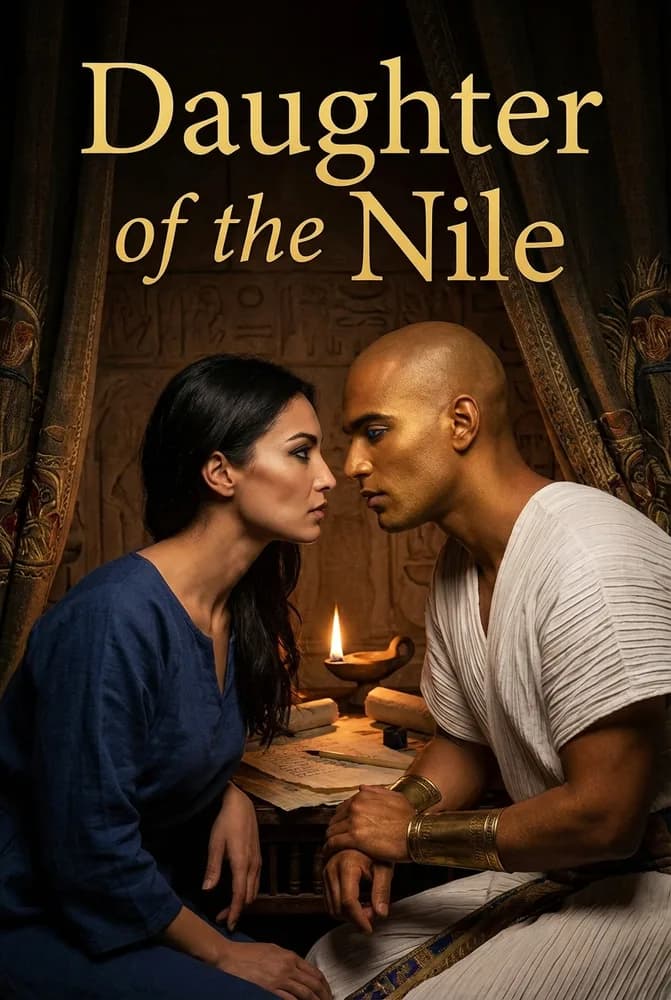
Three rooms overlooking the river, with walls painted in scenes of lotus blossoms and ibises. Furniture inlaid with ivory and lapis lazuli. A bed large enough for four people, draped in linen so fine it was nearly transparent. A balcony where the evening breeze carried the scent of jasmine from gardens I couldn't see.
And a door that connected to a private courtyard—one that, according to the servant who'd shown me here, was reserved exclusively for the royal family.
I stood in the doorway to that courtyard now, watching moonlight paint the reflecting pool silver. Palm fronds rustled overhead. Somewhere nearby, a fountain murmured.
This wasn't where you housed a common scribe.
This was where you kept something valuable. Something you wanted close.
Or something you wanted to watch.
I turned back to the main chamber, cataloging exits with the instinct of someone who'd spent half her life preparing to run. The main door, guarded—I'd heard the shift change an hour ago. The balcony, a three-story drop to the river. The courtyard...
I moved through it slowly, bare feet silent on warm stone still holding the day's heat. The space was small, intimate. Flowering vines climbed the walls. More of those lotus blossoms floated in the pool, their perfume thick and sweet.
And there, on the far side—another door.
I knew I shouldn't. Knew it was probably exactly what he expected me to do.
I tried the handle anyway.
Locked.
"Curious creature, aren't you?"
I spun, heart hammering.
A woman stood in the shadows of the colonnade, so still I'd missed her entirely. As she stepped into the moonlight, I understood why the servant who'd mentioned her name had done so with reverence.
Neferet.
The Pharaoh's half-sister moved like water, her white linen dress clinging to curves that would make sculptors weep. Kohl lined her eyes, making them enormous in her elegant face. The scent of lotus oil hung around her—the same perfume that had filled the throne room, but on her it seemed richer, more complex.
She was studying me the way a cat studies a mouse it hasn't decided whether to eat.
"Lady Neferet." I bowed, not as low as protocol probably demanded. "Forgive me. I was only—"
"Exploring your new home?" Her smile was knowing. "How thorough of you. Tell me, did you find the balcony escape route adequate, or were you hoping the courtyard might offer better options?"
My mouth went dry.
She laughed, a sound like honey and poison mixed together. "Oh, don't look so stricken. We all assess our surroundings when first arriving at court. The wise ones, anyway." She moved closer, circling me with that same predatory grace. "And you strike me as very wise, Kallista of Rhodes."
The way she said my city's name—with just the faintest emphasis—made it clear she knew exactly what Rhodes meant. What had happened there.
What I'd done to survive it.
"I'm only a scribe," I said carefully.
"Of course you are." She stopped in front of me, close enough that I could see the tiny flecks of gold in her dark eyes. "Just as I'm only a widow. Just as my brother is only a king." Her hand came up, fingers cool against my chin, tilting my face to the moonlight. "We all wear masks in this place, little spy. The question is whether yours will protect you or suffocate you."
I should have been terrified. I was terrified.
But there was something almost... sympathetic in her gaze.
"He put you in these rooms for a reason," she continued, releasing me. "Three doors to watch, all of them leading somewhere he controls. The servants are his. The guards are his. Even the air you breathe in this palace belongs to him." She turned away, trailing her fingers through the pool. "Everything here is his."
"Then why tell me this?"
"Because I'm curious." She glanced back over her shoulder. "My brother has never taken an interest in foreign scholars before. Oh, he's had spies in his court—Ptahmose makes sure of that. But he's never kept one close. Never given one access to genuine intelligence." Her eyes narrowed. "So either you're the most brilliant operative Greece has ever produced, or..."
"Or?"
"Or he's playing a game so complex even I can't see all the pieces yet." She moved back toward the shadows. "And that, little scribe, should frighten you far more than anything else."
She was almost gone when I found my voice again.
"That door." I gestured to the locked entrance. "Where does it lead?"
Neferet's smile was sharp as a blade.
"His chambers, of course. Where else?"
---
Sleep was impossible.
I lay in that enormous bed, staring at the ceiling, trying to make sense of the trap I'd walked into. Every instinct screamed at me to run. To find a way out of the palace, out of Thebes, back to—
Where?
Rhodes was ash. My family was dead. The coalition that had sent me here would kill me themselves if I returned empty-handed.
And Khemweset knew all of it.
He'd looked at me in that throne room and seen every desperate, compromised choice that had led me to his court. Had seen through my forged credentials and careful lies to the truth underneath: I had nowhere else to go.
No wonder he'd smiled.
I pressed my palms against my eyes, trying to slow my racing thoughts. Trying to think like the scholar I'd once been, before survival became my only skill.
What did he want? Really want?
Not just a spy to feed false information to Greece—he could have done that without revealing himself. Not just someone to translate correspondence—half his court probably spoke Greek.
I need someone who understands how the game is played from both sides.
That's what he'd said. Someone who knew how Greece thought, how they strategized. Someone who could help him anticipate their moves.
Someone who could help him win.
The realization settled over me like cold water.
He didn't want a spy.
He wanted a weapon.
---
Morning brought a servant with breakfast and instructions: I was to report to the House of Scrolls to begin my duties. The diplomatic correspondence awaited.
The House of Scrolls turned out to be a columned hall near the administrative wing, its walls lined with cubbies holding thousands of papyrus documents. The scent of ink and dust reminded me so sharply of my father's library that I had to stop in the doorway, breathing through the ache.
"Kallista of Rhodes?"
An elderly scribe looked up from his work table, squinting at me through the morning light. His hands were as ink-stained as mine, his back curved from decades of bending over scrolls.
"I'm to work on diplomatic translations," I said.
He grunted, gesturing to a table in the corner. "Correspondence is there. Pharaoh's orders—you're to handle anything in Greek, Hittite, or Akkadian." He paused. "And you're to report directly to him on anything... interesting."
Of course I was.
The stack of documents was substantial. I settled onto the scribe's bench, arranged my tools, and began to read.
Within an hour, I'd confirmed my suspicions.
The correspondence was real. Genuine diplomatic communications from Greek city-states, Hittite officials, Babylonian merchants. Nothing falsified, nothing staged for my benefit.
Which meant Khemweset was giving me actual intelligence.
The question was why.
I was three scrolls deep into a tedious trade dispute when I felt it—that prickling awareness of being watched. I looked up.
Ptahmose stood in the doorway.
The High Priest wore his leopard skin over white linen, the spotted pelt draped across one shoulder. Frankincense smoke clung to him like a second skin, thick and cloying. His amber eyes studied me with the same calculating interest Neferet had shown, but without any of her dangerous warmth.
This was a man who saw people as pieces to be moved or removed.
"The foreign scribe," he said, his voice like oil over stone. "How fortunate that Pharaoh found someone so... qualified."
I set down my reed pen carefully. "High Priest. May I help you?"
"I was simply curious." He moved into the room, hands folded in front of him. "It's unusual for our lord to take such personal interest in a scribe's appointment. Usually these matters are handled by the administrative staff." His smile didn't reach his eyes. "But then, you're no ordinary scribe, are you?"
Every muscle in my body tensed.
"I have some skill with languages," I said evenly. "Nothing more."
"Hmm." He picked up one of the scrolls I'd already translated, scanning my notations. "Rhodes, wasn't it? Terrible business, what happened there. The siege, the fires..." He set the scroll down. "So many dead. So few survivors."
The threat was delicate as spider silk and just as strong.
"I was fortunate," I managed.
"Indeed." He moved closer, and I had to force myself not to lean away from that frankincense cloud. "Fortune favors the clever, they say. Those willing to do whatever necessary to survive." His eyes locked on mine. "I appreciate such pragmatism. It makes people... predictable."
He let that hang in the air between us.
"I should return to my work," I said. "The Pharaoh expects these translations completed."
"Of course. Pharaoh's will is absolute." But he didn't move. "A word of advice, though, from someone who has served the throne far longer than our young king has worn the crown: loyalty in this court is a commodity. Valuable to those who know how to spend it wisely."
"I'll remember that."
"Do." He turned to leave, then paused. "Oh, and Kallista? Be careful which gods you pray to in this land. Some are more forgiving of foreign worship than others."
The frankincense smell lingered long after he'd gone.
---
The formal banquet that night was a lesson in Egyptian court politics delivered with the subtlety of a knife between the ribs.
I'd been provided appropriate clothing—a dress of pleated linen that left my shoulders bare, a wide collar of faience beads, golden cuffs for my wrists. A servant had lined my eyes with kohl and arranged my hair in the Egyptian style, braids woven with lotus flowers.
Looking at my reflection, I barely recognized myself.
The banquet hall was magnificent. Columns painted with hieroglyphs rose to a ceiling decorated with golden stars. Musicians played in the corner, the sound of lyres and flutes mixing with conversation. The scent of roasted meat, honey cakes, and wine filled the air.
I was seated at a table with minor officials and their wives—high enough to observe the important guests, low enough to be beneath notice.
Or so I thought.
Khemweset entered like a storm given human form.
He wore gold. Gold collar, gold cuffs, gold sandals. The double crown of Upper and Lower Egypt sat on his head, and the false beard of kingship jutted from his chin. But it was the way he moved that commanded attention—that absolute certainty, that magnetic pull of power.
The entire room fell silent.
He took his seat at the high table, Neferet beside him in a dress of silver linen. And on his other side...
Ptahmose.
The High Priest leaned close to say something, and I watched Khemweset's expression—polite, attentive, revealing nothing.
"Quite the sight, isn't he?"
I turned to find the woman beside me smiling knowingly. She was perhaps forty, with the comfortable roundness of wealth and the sharp eyes of a survivor.
"The Pharaoh?" I said carefully.
"Mmm. Though I meant the High Priest. Watch how he positions himself—always at the king's right hand, always whispering." She sipped her wine. "Ptahmose raised our Pharaoh, you know. Served as regent during his minority. Some say he still thinks of the boy as his to control."
"And is he?"
Her smile widened. "That, my dear, is the question everyone in this room is trying to answer."
The feast began. Course after course of delicacies I couldn't name, wine that tasted of honey and dates. I ate mechanically, my attention fixed on the high table.
Ptahmose was speaking again, his voice too low to hear but his gestures expansive. Several other priests at nearby tables leaned forward, listening.
Khemweset's expression remained neutral.
Then the High Priest raised his voice, clearly intending to be heard.
"...which is why, divine one, the priests of Amun question the wisdom of provoking the Hittites with increased patrols along the northern border. The gods favor peace, not the reckless aggression of youth."
The room went very, very quiet.
I stopped breathing.
Khemweset set down his wine cup with deliberate care. When he spoke, his voice carried effortlessly across the hall.
"The gods favor Egypt's strength, High Priest. Or have you forgotten that Amun-Ra himself is a warrior god?" He smiled, and it was the same dangerous smile he'd given me in the throne room. "As for youth—I believe Alexander was younger than I am when he conquered half the world. Should we aspire to less because we're Egyptian?"
Several people gasped. You didn't invoke Alexander in an Egyptian court. Not favorably.
Ptahmose's face remained serene, but his knuckles whitened on his wine cup. "Alexander died young and mad, his empire crumbling before his body was cold. Perhaps not the example our divine Pharaoh should follow."
"Perhaps." Khemweset leaned back, utterly relaxed. "Or perhaps the lesson is that hesitation kills empires faster than boldness ever could."
The tension was thick enough to choke on.
Neferet laid a hand on her brother's arm, saying something too quiet to hear. The moment broke. Conversation resumed, forced and brittle.
But I'd seen it now—the fault line running through the palace. Pharaoh and High Priest, locked in a struggle for control of Egypt itself.
And somehow, I'd landed directly between them.
---
I was halfway back to my quarters when a servant intercepted me.
"The Pharaoh requests your presence in the southern garden."
My stomach dropped. "Now?"
"Now."
The southern garden was smaller than the courtyard outside my rooms, tucked away behind the administrative wing. Torches flickered in bronze sconces, casting dancing shadows across flowering vines and fruit trees.
Khemweset stood beside a fountain, the double crown removed, his collar and cuffs discarded. In just the white linen kilt and the moonlight, he looked less like a god-king and more like a man.
A very dangerous man.
"You're observant," he said without turning. "I saw you watching during dinner."
I stayed near the entrance, maintaining distance. "It was hard to miss."
"Ptahmose thinks I'm reckless. Impulsive." He turned then, and the torchlight caught in his obsidian eyes. "What do you think?"
The question felt like a test.
"I think you wanted him to make that challenge publicly," I said slowly. "I think you're forcing him to show his hand."
His smile was sharp and pleased. "Very good. And?"
"And I think you're making enemies faster than you can eliminate them."
"Now you sound like my sister." He moved closer, and I caught that scent again—myrrh and cedar and blue lotus oil. "But you're not wrong. Which is why I need you to send your first report to your Greek handlers."
I blinked. "Already?"
"Tomorrow." He was close enough now that I had to tilt my head back to meet his eyes. "I'll provide the information. You'll encode it in whatever system they taught you. And you'll send it through whatever channels you've established."
"What information?"
"Troop movements along the northern border. Grain shipments to the army. Supply routes." His gaze never left mine. "All of it accurate."
My heart hammered. "You're giving them real intelligence."
"I'm giving them exactly what I want them to know." He reached up, and I froze as his fingers brushed my cheek, adjusting one of the lotus flowers woven into my hair. The touch was feather-light, almost casual. "There's a difference."
I couldn't breathe. Couldn't think past the heat of his hand so close to my face, the scent of him surrounding me, the weight of his attention like a physical thing.
"Why?" I managed.
"Because I'm going to use you to feed Greece exactly the information that will make them do what I want." His hand dropped, but he didn't step back. "And in return, you're going to help me outmaneuver Ptahmose before he orchestrates another convenient royal death."
The words hit like cold water. "Another?"
"My father didn't die of illness, Kallista. He was poisoned." His expression was utterly calm, utterly controlled. "The priests wanted a king they could control. They got me instead."
"And you think Ptahmose—"
"I know Ptahmose was involved. I just can't prove it yet." He finally stepped back, giving me space to breathe. "Which is where you come in."
"I'm a translator, not an investigator."
"You're a survivor who understands how powerful men think. How they scheme." His eyes glittered in the torchlight. "You've spent years watching for threats, reading between lines, staying one step ahead of people who wanted to use you. Don't pretend you haven't noticed how this court works."
He was right. Gods help me, he was right.
"What exactly do you want me to do?"
"For now? Exactly what you came here to do. Translate correspondence. Observe the court. Send reports to Greece." He moved toward the garden exit, then paused. "Oh, and Kallista? Don't bother trying to send secret messages your handlers didn't authorize. I have people watching your people watching you."
"Then what's the point of any of this?"
He looked back, and his smile made something low in my belly clench.
"The point, my clever little spy, is that everyone in this palace is playing a game. The question is whether you're brave enough to play to win instead of just survive."
He left me standing there, pulse racing, mind spinning.
I'd thought I understood the trap I'd walked into.
I'd been wrong.
This wasn't a cage at all.
It was a battlefield.
And Khemweset had just handed me a weapon and asked me to choose a side.