The morning sun turned my quarters into a furnace by the time the guards arrived.
"The Pharaoh requests your presence in his private study."
Requests. As if I had a choice.
I'd spent the night dissecting Khemweset's parting words, turning them over like a scholar examining fragments of broken pottery, trying to reconstruct the whole vessel from pieces that didn't quite fit. Play to win instead of just survive. What did winning even look like when the game board was a palace full of people who'd been playing since before I was born?
The guards led me through corridors I hadn't seen before, deeper into the royal wing. Fewer decorations here. More guards. This was the working heart of the empire, not the gilded showcase for foreign dignitaries.
The study was smaller than I expected. Intimate, almost.
That should have been my first warning.
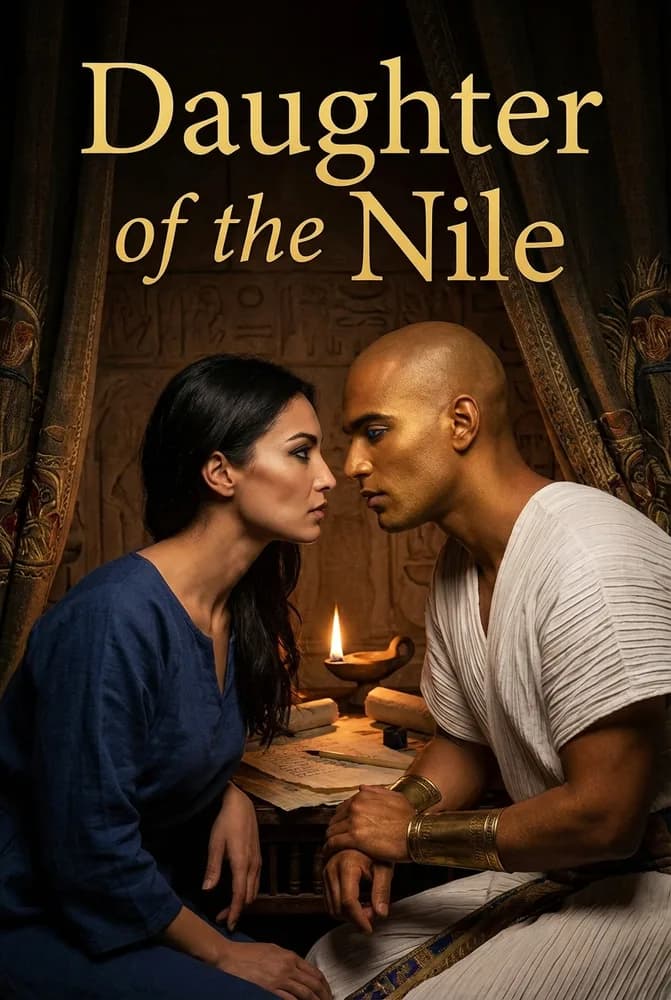
Khemweset sat behind a desk of dark wood inlaid with ivory, scrolls spread before him like battle plans. He'd forgone the heavy ceremonial collar today, wearing only a simple white linen kilt and broad belt of tooled leather. His chest was bare except for a single gold chain, and the morning light through the high windows turned his skin to bronze.
He looked up as I entered, and something flickered in those obsidian eyes.
"Kallista of Rhodes. Sit."
A chair had been placed directly across from him. Close enough that I could smell the myrrh and cedar oil on his skin, mixed with something else—papyrus and ink, the scent of scholarship. It unsettled me, finding that commonality.
I sat.
"I've decided," he said, returning his attention to the scrolls, "that if you're going to spy on my correspondence, you might as well do it properly. These are dispatches from the Nubian border. Translate them."
He slid three scrolls across the desk.
I unrolled the first, scanning the hieratic script. A military report—troop movements, supply requisitions, a dispute between two commanders about strategic positioning near the third cataract.
"This is sensitive information," I said carefully.
"Yes."
"You're just... giving it to me?"
His smile was sharp as a blade. "You're my translator. How else would you access it?"
The trap was obvious. Too obvious. He wanted me to take this information, to send it to my handlers in Greece. But why? To test my loyalty? To feed false intelligence? To see what I'd do with it?
I picked up my stylus and began translating onto a fresh sheet of papyrus, hyperaware of his gaze on my hands as I worked. My fingers were steady despite the heat building under my skin.
"Your script is excellent," he observed after several minutes of silence. "Who taught you?"
"My father. He was a merchant who believed education was the only wealth that couldn't be stolen."
"Was?"
"Rhodes burned. He didn't make it out."
I didn't look up from the translation, but I felt the quality of his attention shift. Sharpen.
"I'm sorry."
"Don't be. You didn't set the fires."
"No. But I understand what it is to lose family to politics."
My hand paused mid-stroke. I thought of the rumors about his father's death, the whispers of poison and palace intrigue. When I glanced up, his expression was unreadable.
"The second scroll," he said, as if the moment hadn't happened. "What does it say about the Hittite delegation?"
I unrolled it, translating as I read. "They're requesting an audience to discuss... trade routes through Syria. They're offering tribute of copper and—" I stopped.
"And?"
"This can't be right. They're offering to share intelligence about Assyrian military movements?"
"Why can't that be right?"
"Because the Hittites hate Egypt. This is either a trap or..." I studied the script more closely, noting the formal phrasing, the specific diplomatic formulae. "Or they're more afraid of Assyria than they are of you."
"Which means?"
He was testing me. Not my translation skills—my strategic thinking.
"Which means the balance of power is shifting. If the Hittites are desperate enough to ally with their traditional enemy, Assyria must be planning something significant." I met his eyes. "Something that threatens everyone."
The smile that curved his mouth made my pulse skip.
"Go on."
"You're considering the alliance. You'd be a fool not to. But you can't trust them, which means you need independent verification of their intelligence before you commit resources." I tapped the papyrus. "This is a test. You'll give them something they want—limited trade access, perhaps—in exchange for their first report. If it proves accurate, you negotiate further. If it's false, you've lost nothing."
"And if I were to send a diplomatic mission to Hittite territory to negotiate these terms, what would you advise?"
"I'd advise you to send someone expendable who speaks their language and can read the subtext of every conversation." I held his gaze. "Someone like a foreign translator who's already proven she can survive hostile environments."
His laugh was low and genuine, and it did dangerous things to my concentration.
"You're wasted on the Greeks, Kallista. They're using a siege engine to crack walnuts."
"Meaning?"
"Meaning they want you to count my ships and report my troop movements like a common spy. They don't understand what you actually are."
"And what am I?"
He leaned forward, elbows on the desk, close enough that I could see the gold flecks in his dark eyes.
"A weapon that thinks."
The air between us felt charged, electric. I should have leaned back, created distance. Instead, I found myself frozen, caught in the gravity of his attention like a moth circling flame.
"The third scroll," I managed, voice rougher than intended.
He held my gaze for another heartbeat before settling back in his chair. "The third scroll is poetry. A gift from a minor prince seeking to curry favor. Translate it."
I unrolled the papyrus with hands that wanted to tremble. The script was formal, flowery—a love poem comparing the prince's devotion to the flooding of the Nile, inevitable and life-giving.
"It's terrible," I said.
"I know. But tell me why."
"The metaphors are mixed. He compares you to both the sun and the Nile, which are opposing forces—one brings drought, the other relief. And the meter is inconsistent, like he's translating from another language poorly."
"He is. It's originally Akkadian. He thinks I won't notice because most Egyptian scholars don't read Akkadian."
"But you do."
"I speak six languages, Kallista. Seven, if you count the diplomatic double-speak that passes for negotiation in this palace." He paused. "How many do you speak?"
"Eight." I couldn't quite keep the pride from my voice. "Nine if you count Demotic as separate from hieratic Egyptian."
"Show off."
The casual humor surprised a laugh out of me, and his expression softened almost imperceptibly.
We worked through the morning like that—him presenting me with documents, me translating and analyzing, our conversation flowing from politics to strategy to the finer points of Sumerian grammar. He was brilliant, sharper than anyone I'd sparred with intellectually since my father's colleagues in Rhodes. And he seemed to genuinely value my opinions, pushing back when he disagreed, conceding points when I made my case.
It was intoxicating.
Also terrifying.
Because I couldn't tell what was real and what was performance. Was this who he actually was in private, or just another mask? Every piece of information he shared could be truth or carefully crafted lie. Every moment of connection could be genuine or calculated manipulation.
And the worst part?
I was starting not to care.
"Enough for today," he said finally, as the sun climbed toward its zenith. "You'll return tomorrow morning. Same time."
"Is this going to be a regular occurrence?"
"Would you prefer to go back to translating grain requisitions?"
"I'd prefer to understand what you're doing."
He stood, moving around the desk with that predatory grace. I rose as well, refusing to let him loom over me, but it meant we were standing close. Too close.
The scent of myrrh and cedar wrapped around me like smoke.
"I'm doing exactly what I said, Kallista. Letting you play the game." His voice dropped lower. "The question is whether you're brave enough to play it honestly."
"Honestly? You're a king. You don't know the meaning of the word."
"And you're a spy. Which one of us is more qualified to recognize honesty when we see it?"
I should have had a clever response. Should have deflected with sarcasm or withdrawn behind professional distance.
Instead, I stood there drowning in the heat of his proximity, hyperaware of every inch of space between us—space that felt simultaneously too much and not nearly enough.
He lifted his hand, and I thought for one heart-stopping moment he was going to touch me. Instead, he plucked a drop of ink from my cheek, holding up his stained finger.
"You have the habits of a scholar," he said softly. "Even when you're trying to be a spy."
Then he stepped back, and I could breathe again.
"Go. Rest. Eat something. You look like you're about to fall over."
I fled.
There was no other word for it. I walked with dignity until I was out of his sight, then I fled to my quarters and stood in the center of the room, heart hammering, skin flushed, mind racing.
This was bad.
This was very, very bad.
Because I'd just spent three hours with the man I was supposed to be spying on, and I'd enjoyed every minute of it. More than enjoyed—I'd felt alive in a way I hadn't since Rhodes fell. Challenged. Respected. Seen.
And that was more dangerous than any trap he could set.
━━━━━━━━━━━━━━━━━━━━
The pattern repeated for three days.
Morning sessions in his study, translating documents that ranged from mundane to explosive. He shared information about military deployments, diplomatic tensions, even internal palace politics. We debated strategy and theology, argued about the merits of different writing systems, traded increasingly obscure scholarly references like verbal sparring.
And every session, the air between us grew heavier.
A brush of fingers when he passed me a scroll. The heat of his body when he leaned over my shoulder to examine my translation. The way his eyes lingered on my mouth when I was concentrating.
The way I started wearing the nicer robes my quarters provided, started taking more care with my appearance, started anticipating each morning like a girl awaiting her lover instead of a spy meeting her mark.
I was compromised.
Professionally, ethically, probably fatally compromised.
And I still didn't know if he felt anything real or if this was just another layer of manipulation.
On the fourth day, I decided I needed to do my actual job before I forgot I had one.
The market district of Thebes sprawled along the river like a colorful serpent, merchants hawking everything from Nubian gold to Syrian spices. I'd claimed I needed to purchase new writing supplies—not entirely a lie, I'd been going through papyrus at an alarming rate—and the guards assigned to shadow me seemed content to keep their distance as long as I stayed in public view.
I found the merchant stall I was looking for tucked between a potter and a weaver. The owner, a Greek expatriate named Alexios, sold olive oil imported from home. He also served as a dead drop for messages to my handlers.
"Rhodian blend?" he asked in Greek as I approached, the code phrase casual.
"If it's fresh," I replied, the counter-sign.
He handed me a small amphora, and I passed him coins along with a tightly rolled papyrus hidden in my palm. The message was coded, brief: Pharaoh shares intelligence freely. Possible trap. Troop movements to Nubian border confirmed, numbers attached. Hittite alliance under negotiation. Internal conflict with priesthood evident. Recommend caution.
I didn't mention the daily sessions. Didn't mention how Khemweset looked at me, or how I was starting to look back.
Some intelligence was too dangerous to share.
The walk back to the palace felt longer than it should have. The sun beat down mercilessly, and despite the shade of my linen shawl, sweat gathered at the nape of my neck. I kept replaying the message in my mind, wondering if I'd said too much or too little, if I'd just made a terrible mistake.
The guards let me pass into the palace without comment. I retreated to my quarters, set down my purchases, and tried to calm the anxiety crawling up my spine.
That's when I noticed him.
Khemweset stood in the doorway to my small garden, backlit by the afternoon sun, arms crossed over his chest. He'd changed from his morning simplicity into full royal regalia—the blue and gold striped nemes headdress, the broad collar of lapis and gold, the ceremonial kilt with its jeweled belt.
He looked every inch the god-king.
And he was furious.
No—not furious. Fury was hot, explosive. This was cold. Calculated. The rage of someone who'd been proven right about something he'd hoped to be wrong about.
"Did you enjoy your shopping trip?" His voice was silk over steel.
My mouth went dry. "I needed supplies."
"Mm. And did you find everything you were looking for?"
"Yes."
He moved into the room with predatory grace, and I fought the urge to back away. Running would only confirm guilt, and I needed to maintain the fiction that I didn't know he knew.
Even though we both knew he knew.
God, this palace was exhausting.
"I'm curious," he said, stopping close enough that I had to tilt my head back to meet his eyes. "What did you tell them?"
"I don't know what you mean."
"Don't." The word cracked like a whip. "Don't insult us both by pretending. I told you I had people watching your people watching you. Did you think I was joking?"
The smart play was to keep denying. To act offended, to play the innocent scholar caught up in palace paranoia.
Instead, I met his gaze and told the truth.
"I reported what you've been telling me. Troop movements. The Hittite negotiations. The tension with the priesthood." I lifted my chin. "Exactly what you wanted me to report."
His eyes narrowed. "And what makes you think that's what I wanted?"
"Because you're not stupid, and neither am I. You've been feeding me information for four days, watching to see what I'd do with it. Either it's false intelligence you want my handlers to believe, or it's true intelligence you want them to have for reasons of your own." I took a breath. "Either way, I'm the delivery system, not the message. So yes, I sent the report. Congratulations. Your test worked."
Silence stretched between us, taut as a bowstring.
Then, impossibly, he smiled.
"You know what the most dangerous thing about you is, Kallista?"
"My sparkling personality?"
"Your honesty." He reached out, and this time he did touch me—fingers trailing along my jaw, tilting my face up. "You lie professionally, but when it matters, when someone calls you on it, you default to truth. It's your fatal flaw."
My heart was trying to beat its way out of my chest. His thumb brushed over my lower lip, and I forgot how to breathe.
"Is it fatal?" I managed.
"That depends."
"On what?"
"On what you really think of me."
The question landed like a physical blow. This was it—the real test. Not whether I'd send the message, but what I'd say now, in this moment, with his hand on my face and his eyes burning into mine.
I could lie. Should lie. Should give him some diplomatic non-answer that preserved my cover and my distance.
But he was right about my fatal flaw.
"I think you're brilliant," I said quietly. "I think you're ruthless and calculating and you trust absolutely no one, probably for good reason. I think you're using me, though I can't figure out the endgame. I think you're lonely in a way that has nothing to do with being alone and everything to do with being the only person in any room who can see the whole board."
His thumb stilled against my lip.
"I think," I continued, voice barely above a whisper, "that you're the most dangerous man I've ever met. And I think I'm an idiot for wanting to trust you anyway."
For a long moment, he just looked at me. Then his hand slid from my face to the nape of my neck, fingers tangling in the base of my braid, and he pulled me closer—not into a kiss, but into the space where a kiss might happen, where our breath mingled and every nerve in my body screamed with anticipation.
"Do you know what I think, Kallista of Rhodes?"
"What?"
"I think you're the first honest thing that's walked into this palace in five years. I think your handlers are fools who don't deserve you. I think Ptahmose is going to try to turn you against me, and I think when he does, you're going to have to make a choice about who you really are."
His grip tightened, and I felt it everywhere.
"And I think," he said, voice dropping to something dark and raw, "that I'm an idiot for wanting to trust you too."
Then he released me and stepped back, leaving me swaying on my feet, dizzy with want and confusion.
"The message you sent will reach your handlers. I made sure of it." He moved toward the door, then paused. "Tomorrow morning. Same time. We have work to do."
"What kind of work?"
He looked back, and his smile was pure danger.
"The kind that requires someone fluent in lies."
Then he was gone, leaving only the scent of myrrh and cedar and the feeling of his fingers ghost-like against my skin.
I sank onto the nearest chair, shaking.
I'd thought I understood the game we were playing.
I'd been wrong.
This wasn't about espionage or politics or even the careful dance of mutual manipulation.
This was about two people who'd survived by never trusting anyone, circling each other like wounded animals, trying to decide if the risk of connection was worth the certainty of betrayal.
And I had no idea which one of us would break first.