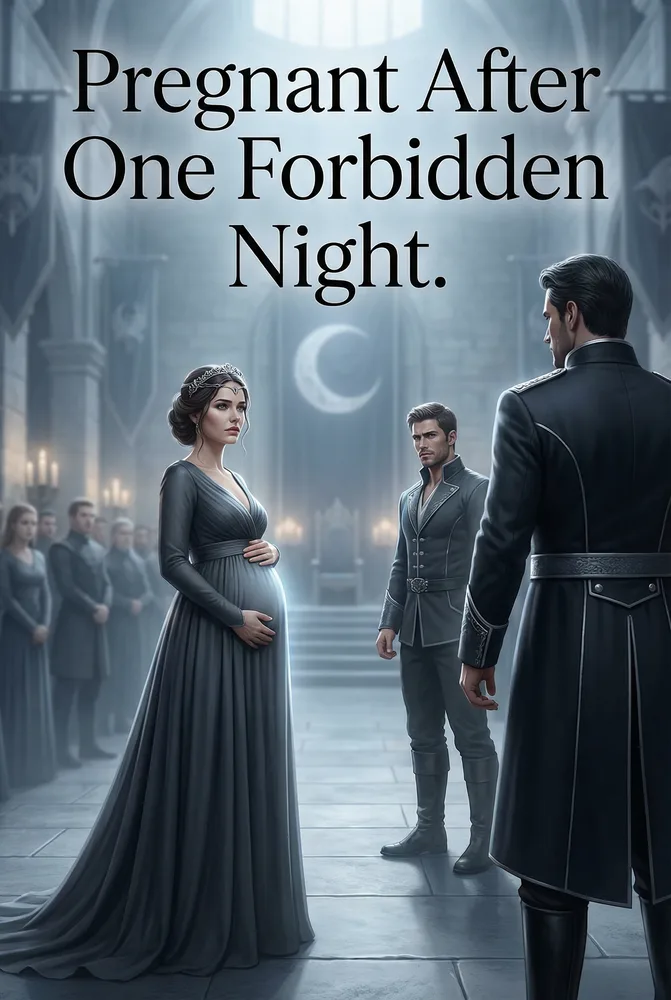
Lysander arrives like a storm front—sudden, electric, and impossible to ignore.
One moment I'm standing in the library trying very hard not to notice how Kael's cedar-and-steel scent has somehow infiltrated the space between us, how the air feels thinner when he's near, and the next moment my oldest friend is materializing from the shadows with the kind of theatrical flair that would be ridiculous if it weren't so perfectly, infuriatingly him.
"Well, well," Lysander drawls, his shoulder-length dark hair catching the lamplight like spilled ink. "Either I've developed a sudden allergy to wards, or someone's been tampering with the perimeter." His sharp black eyes—the kind that seem to absorb light rather than reflect it—flick from me to Kael with the precision of a blade finding its mark. "Do tell me the Church hasn't finally figured out where you've been hiding, Morrigan. I've grown rather attached to not being burned at the stake."
The relief that floods through me at seeing him is immediately complicated by something else. Something that tastes like copper and regret.
"Lysander." I move toward him, and it's automatic—the way my body recognizes its anchor, the person who knows exactly how dark I can be and hasn't run screaming. His scent hits me: exotic spices, smoke, something faintly dangerous like poison masked in perfume. "Your timing is, as always, impeccable."
He pulls me into an embrace that's all casual grace and hidden steel, pressing a kiss to the top of my head. It's the same greeting we've exchanged for seven years, but today it feels like a shield being raised. A statement.
When he releases me, his attention settles on Kael with the warmth of a winter wind.
"And you must be the reason my wards are singing like a wounded animal," Lysander says pleasantly. Too pleasantly. The kind of pleasant that precedes violence in better circles. "How delightful. I'm Lysander Vex. I don't believe we've met, though I've certainly heard the Church's propaganda about your kind."
Kael stands with the rigid posture of a man who's been trained to face threats, which is exactly what Lysander is being. Not physically—not yet—but in every other way that matters. His ice-blue eyes assess my friend with the same intensity he'd use for a battlefield opponent.
"Sir Kael Thornheart," he says, and there's something in his voice that's almost careful. Like he's aware he's being evaluated and found wanting. "I assume you're the one who's been keeping her alive out here."
"How gallant that you assume she needed keeping alive," Lysander replies, moving deeper into the library with the liquid grace that makes him look like he's dancing even when he's just walking. He trails his fingers along the spines of books—my books, books we've gathered together over seven years of careful thievery and trade. "Morrigan's been doing quite well on her own. For, oh, how long has it been, darling? Seven years without the Church's attention?"
The implication hangs there like a blade suspended above water.
I watch Kael process this information, watch his jaw tighten as the implications settle into place. Seven years of isolation. Seven years of choosing the woods and the silence over the possibility of connection. Seven years of building walls so high that even the sky couldn't touch me.
"Seven years," I confirm, moving to the window. Distance. I need distance. The library suddenly feels too small, too warm, like the walls are closing in with the weight of all the things I've never said to anyone but Lysander. "Though I'm sure you'll find that thrilling. More proof of my depravity, no doubt."
"On the contrary," Kael says quietly. "It's proof of your restraint."
I turn to find him watching me with an expression I can't quite parse. There's something in his eyes—something that looks almost like understanding, which is so much more dangerous than condemnation.
Lysander makes a soft sound that might be laughter or might be a warning. "How interesting. The Church's golden boy develops a conscience. Tell me, Sir Thornheart, what brings you to our humble exile? Surely not just to admire Morrigan's self-imposed penance?"
"He defected," I say flatly, because Lysander deserves to know and because saying it out loud makes it real in a way that terrifies me. "Cardinal Thorne sent him to kill me. He didn't."
The silence that follows is the kind that has weight.
Lysander's expression doesn't change, but I can feel the shift in him—the sudden, razor-sharp focus that comes when he's assessing a threat that might be more complex than initially apparent. He moves toward Kael with deliberate slowness, circling like a predator.
"And why," he asks, his voice soft as silk and twice as cutting, "would the Church's most decorated weapon choose exile over obedience?"
Kael doesn't move, doesn't flinch. But I can see his pulse jump in his throat, can watch the moment he decides to answer honestly instead of defensively. The cedar scent of him intensifies—stress, adrenaline, something raw underneath the careful control.
"Because," Kael says slowly, "I realized I've spent fifteen years serving a lie. And she"—his eyes find mine across the library—"is the most real thing I've ever encountered."
Oh, that's not fair. That's not fair at all.
I can feel my heartbeat in my throat, can feel the dangerous warmth spreading through my chest like spilled wine. This is what I've been afraid of—this moment where someone sees me and doesn't look away, doesn't recoil, doesn't try to burn me out of existence.
Lysander makes a low sound that might be approval or might be a threat. "How poetic. How utterly, dangerously foolish." He settles into one of the reading chairs with the grace of a cat, gesturing for Kael to sit. It's not an invitation; it's a command disguised as courtesy. "Sit. We need to talk about what you've done, and more importantly, what you're going to do next."
The next hour unfolds like a dissection.
Lysander, with the precision of a surgeon and the cruelty of an artist, extracts Kael's entire history. He asks about the Church's training, about the missions, about the specific ways they broke him down and rebuilt him as a weapon. And Kael—to his credit—answers. He doesn't minimize, doesn't justify, doesn't hide behind the righteousness that I'm sure he was taught to wear like armor.
I watch from my position near the window, watching the way Lysander leans forward as Kael talks about the orphanage, about Cardinal Thorne finding him at eight years old and promising him purpose. The way my friend's sharp features soften almost imperceptibly when Kael describes the first mission that went wrong, the first time he realized that faith and fear weren't the same thing.
"And the witch hunts," Lysander says, his voice deceptively light. "You participated in those?"
Kael's hands clench into fists. "Yes."
"How many?"
"Forty-seven confirmed kills. Another dozen or so where I'm not certain they were actually witches or just convenient scapegoats."
The number sits in the air like a stone dropped into still water. Forty-seven. Forty-seven people, and Kael's voice when he says it is the voice of a man carrying those deaths like physical weight.
I should feel something about this. Rage, maybe, or fear. Instead, I feel the complicated ache of understanding—knowing that he was a weapon, that weapons don't choose their targets, and that the realization of what he's done is clearly eating him alive from the inside out.
"And you expect Morrigan to simply forgive this?" Lysander asks, though his tone suggests he's already assessing the answer.
"No," Kael says immediately. "I don't expect anything. I deserve nothing. But I'm choosing differently now, and I'm choosing to help her, and if that's not enough, then I'll leave."
Lysander leans back in his chair, studying Kael with an expression I know well. It's the look he gets when he's deciding whether to trust someone, when he's weighing the value of their words against the truth of their actions.
"Do you know what she gave up?" he asks quietly. "To survive? To keep herself safe?"
Kael doesn't answer, but he's watching me now, and I can feel the weight of his attention like a physical thing.
Lysander continues, his voice taking on the cadence of someone telling an old story. "Seven years ago, Morrigan was hunted by the Church. They'd decided she was a threat—probably because she was, but also because she was convenient. A powerful witch, living openly, refusing to hide or recant or beg for mercy. So they sent people after her. Good people, mostly, people who believed they were doing God's work."
I close my eyes, but I can still see it—the flames, the screaming, the way the forest burned when I defended myself.
"She killed them," Lysander says, and there's something in his voice that might be grief. "And then she killed the next batch. And the next. Until finally, she realized that the only way to survive was to disappear completely. To cut herself off from everyone and everything. To become a ghost."
"Lysander—" I start, but he holds up a hand.
"He needs to understand," my friend says softly. "He needs to know what he's asking for when he looks at her like she's something worth saving."
Kael's jaw is tight, his hands still clenched. "What did she give up?"
"Everything," Lysander answers. "Her name, her home, her family. The only person she's allowed close in seven years is me, and that's only because I'm equally cursed and equally dangerous. She's built her entire existence around the principle that connection equals destruction. That loving someone means signing their death warrant."
The library feels smaller now, the air thicker. I can feel my magic responding to the emotional weight of this conversation, can feel the wards humming with agitation around the edges of the property.
"So when you waltz in here claiming redemption and defection and whatever other pretty words you want to use," Lysander continues, his black eyes boring into Kael's, "you need to understand that you're not just asking her to trust you. You're asking her to dismantle seven years of survival strategies. You're asking her to hope, and hope is the most dangerous thing of all for someone like Morrigan."
The silence that follows is absolute.
I can't look at either of them. Can't bear to see the pity in Lysander's eyes or the intensity in Kael's. Instead, I focus on the window, on the forest beyond, on the way the shadows are starting to lengthen as evening approaches.
"I'm not asking her to hope," Kael says finally, and his voice is so quiet I almost miss it. "I'm asking her to let me be here while she figures out what she wants to do next."
Lysander makes a soft sound that might be laughter. "How very diplomatic. And if what she wants is for you to leave? If she decides that the risk is too great and you're too dangerous?"
"Then I leave," Kael says simply. "But I won't pretend to not want her. I won't lie about what I feel. And I won't run unless she tells me to."
I can feel Lysander's attention shift toward me, can feel him waiting for my response. This is the moment where I'm supposed to confirm that yes, Kael should leave, that yes, the risk is too great, that yes, I'm better off alone.
But my mouth is dry, and my heart is racing, and the cedar-and-steel scent of Kael is making my thoughts scatter like frightened birds.
"He's staying," I hear myself say. "For now. Until we figure out what the Church knows and what they're planning."
It's a logical reason. A strategic reason. It has absolutely nothing to do with the way my body responds to his proximity or the way his voice makes something in my chest feel less frozen.
Lysander studies me for a long moment, and I watch as something in his expression shifts. Understanding, maybe. Or resignation. Or perhaps the complicated affection of someone who's watched you suffer and finally sees a possibility—however fragile—of you choosing something other than pain.
"Well then," he says, standing with fluid grace. "I suppose we have planning to do. The Church doesn't send its best weapon after someone without reason, and they certainly don't abandon the hunt after one failure." He moves toward the kitchen, his movements deliberately casual. "I'll make tea. We're going to need it."
After he disappears into the other room, I become acutely aware of being alone with Kael.
He's still sitting in the chair Lysander vacated, but his attention is entirely focused on me. His ice-blue eyes track my every movement, every breath, every involuntary response of my body to his presence.
"He loves you," Kael says quietly.
"Yes," I acknowledge, moving to the bookshelf to fidget with something, anything that isn't his face. "But not like that. He's my anchor. The person who keeps me tethered to humanity when the isolation starts to feel like the only rational choice."
"And if I'm a threat to that?"
I turn to face him, and the question hangs between us like a blade.
"Then he'll protect me from you," I say flatly. "And he'll be right to do it. Lysander's instincts are rarely wrong about people."
Kael stands, and suddenly the space between us feels impossibly small. The library that seemed so vast just moments ago has contracted to the distance between his body and mine. I can smell the cedar and steel more clearly now, can feel the heat radiating from him like a furnace.
"What are his instincts telling him about me now?" he asks, and there's something in his voice that sounds almost like a plea.
I should step back. Every survival instinct I've honed over seven years of isolation is screaming at me to create distance, to shore up walls, to remember that vulnerability is another word for weakness.
Instead, I meet his gaze and speak the truth.
"That you're dangerous," I say softly. "But not in the way the Church trained you to be. That you're a threat to my carefully constructed solitude. And that if I'm not careful, I might actually let you matter."
Kael takes a step toward me, and I don't move away.
"Is that what you want?" he asks. "For me to matter?"
"No," I whisper, but it's a lie and we both know it.
He's close enough now that I can feel the heat of him, close enough that my heart is hammering against my ribs like something wild trying to escape a cage. His hand comes up, and for a moment I think he's going to touch me, and the anticipation is almost unbearable—a sharp, sweet ache that makes my breath catch.
But Lysander's voice drifts in from the kitchen: "Tea's ready! Don't do anything I wouldn't do!"
Kael's hand drops, and he steps back with visible reluctance.
"Everything okay in there?" Lysander calls, and there's definitely amusement in his tone now.
"Fine," I call back, my voice steadier than my hands. "Just discussing strategy."
Kael's mouth quirks into something that might be a smile, and there's a knowing look in his eyes that makes heat rise in my cheeks.
We join Lysander in the kitchen, where he's arranged tea with the precision of someone performing a ritual. He watches us both with sharp attention as we settle around the small table, and I can feel him cataloging every interaction, every hesitation, every moment where the air between Kael and me seems to crackle with something neither of us is quite ready to name.
"So," Lysander says, pouring tea with deliberate care, "tell me everything about the Church's current operations. And don't leave anything out. If we're going to keep our dear Morrigan safe, I need to know exactly what we're up against."
As Kael begins to talk, I watch my oldest friend and my newest complication navigate the space between alliance and opposition. And somewhere deep in my chest, beneath the fear and the walls and the seven years of carefully constructed isolation, something that feels dangerously like hope begins to unfold.
It's terrifying.
It's also, I'm beginning to realize, inevitable.
Lysander catches my eye across the table, and the look he gives me is complicated—protective and resigned and somehow accepting all at once. He knows what's happening. He's known since the moment Kael walked into this library and looked at me like I was something worth saving.
And despite his warnings, despite his interrogation, despite everything he's said about the danger of connection, I watch him deliberately turn his attention back to Kael's story, giving us space.
My anchor is, I realize, letting me choose.
That might be the most dangerous thing of all.