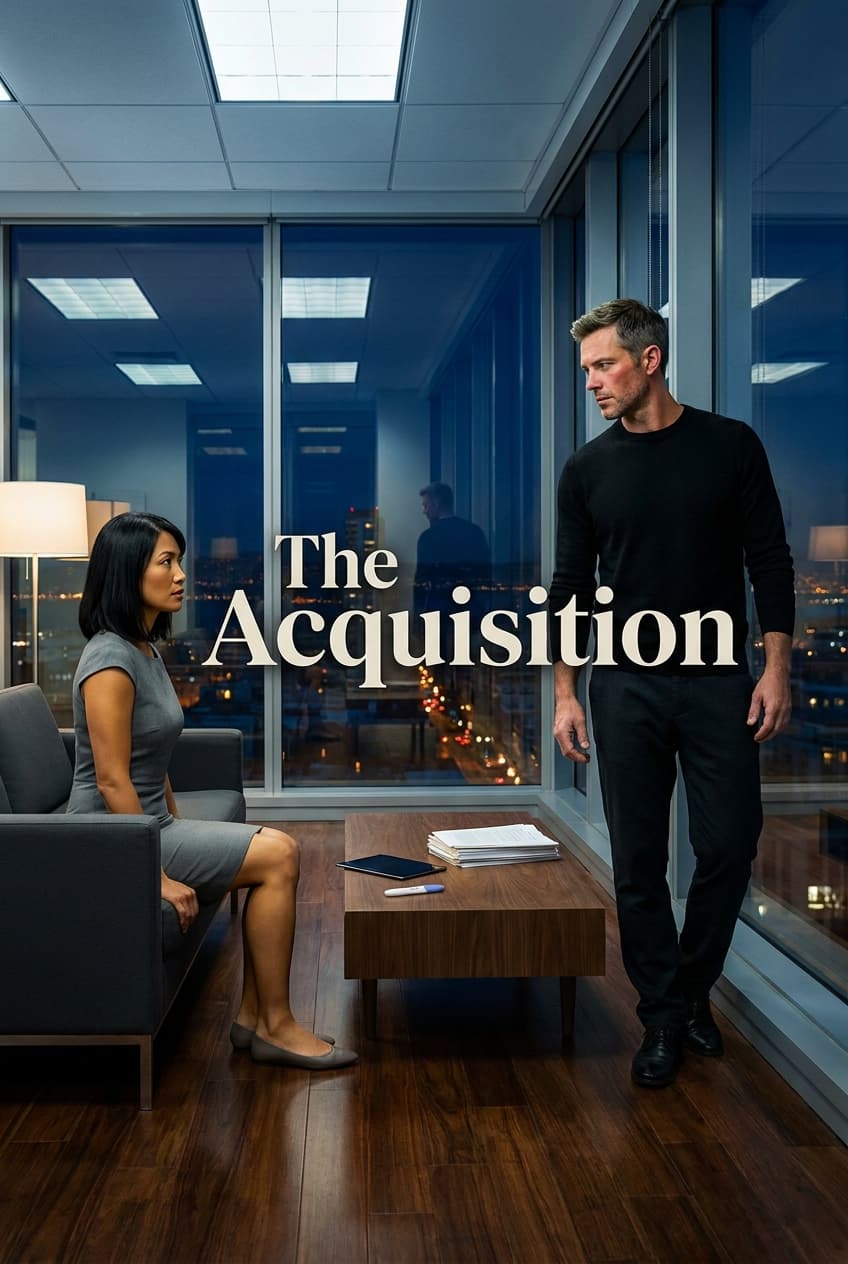
The conference room on the forty-second floor of Ashford Capital smells like old money and furniture polish. I know this smell. I've learned to recognize it the way other people recognize danger—instinctively, with the kind of awareness that comes from having been burned.
My hands are steady as I arrange my materials across the obsidian table. That's the first rule I learned after everything fell apart three years ago: never let them see you shake.
The folder slides into position with a soft whisper of expensive paper. The presentation deck glows on the screen behind me, each slide a small prayer that someone—anyone—will understand what I've built. My AI infrastructure isn't just revolutionary. It's salvation. It's the difference between my firm surviving another quarter or becoming another cautionary tale whispered about at industry cocktail parties.
It's everything.
"They're ready for you," the assistant says from the doorway. She's young, probably hasn't yet learned that working for people like this requires a kind of emotional anesthesia.
I nod without looking at her. The scar along my left collarbone itches—it always does when I'm about to risk something. A nervous habit my therapist would probably want to talk about if I actually went to therapy, which I don't, because therapy requires admitting you're broken and I've spent three years proving I'm not.
The elevator ride up felt shorter than it should have. Time does that when your future is being decided in the next thirty minutes.
Julian Ashford is already seated when I walk in, and the first thing I notice is that he doesn't look up.
This is a power play. I recognize it because I use it myself. Let the other person walk in. Don't acknowledge their presence until they've had time to feel small. It's effective. It's also the kind of thing men like him have been doing since birth, so automatic they probably don't even realize they're doing it.
I decide immediately that I'm going to enjoy making him realize it.
"Mr. Ashford." I keep my voice level, professional—the voice I use when I'm armor-plating myself. I extend my hand across the table, forcing him to either acknowledge me or be visibly rude.
He looks up.
Jesus.
The photographs don't do him justice. That's my first stupid thought, and I hate myself for having it. I've built a career on not having stupid thoughts. Julian Ashford is objectively attractive—that's data, nothing more. Steel-gray eyes. Sharp jawline. The kind of tailored suit that costs more than most people's rent. This is information. This is not a reason to feel like someone just turned up the temperature in the room.
"Ms. Harper." He takes my hand, and the contact is brief but deliberate. His grip is firm without being aggressive, his skin warm. He smells expensive—bergamot and leather and something else, something aged like good whiskey. "I've read your file."
"Then you know why I'm here." I sit before he invites me to, because I'm not going to wait for permission in my own pitch. "And you know this is the investment opportunity you should have been looking for five years ago."
A smile plays at the corner of his mouth. Not a genuine one. The kind that says he's amused by something, but not in a way that's going to help me.
"Your firm is hemorrhaging capital," he says, and there's no malice in it—that's almost worse. He's stating facts the way someone might comment on the weather. "You've had three failed ventures in the last eighteen months. Your last two investors pulled out. Your team is fractured."
He's not wrong. Any of it.
The anger that flares in my chest is sharp and immediate, and I use it. Anger is useful. Anger is better than the alternative—which is admitting that he's right, that I'm desperate, that I'm sitting in this conference room because I'm out of options and out of time.
"My firm is in transition," I correct, leaning forward slightly. "There's a difference. The failures you're referencing were learning experiences. The investors who pulled out did so because they didn't have the vision to understand what I was building. And my team is exactly as fractured as any startup team whose founder is trying to save a sinking ship while simultaneously engineering the future."
I pull up the first slide. "What I have here is proprietary AI infrastructure that will revolutionize data processing at scale. It's not theoretical. It's not a concept. It's functioning code that's already processing three million transactions a day. I need capital to scale it. With your backing, we'll own the market within eighteen months."
"You'll own the market," he repeats, and now there's definitely amusement in his voice. "That's confidence."
"That's accuracy." I hold his gaze. "I don't deal in false modesty, Mr. Ashford. I've learned that it wastes everyone's time. You're not here because you like to be flattered. You're here because your algorithm flagged my application as potentially interesting, and now you're trying to decide if I'm brilliant or just delusional."
Something shifts in his expression. It's subtle—just a tightening around the eyes, a slight change in the angle of his jaw. Interest. Real interest, the kind that can't be faked.
"And which are you?" he asks.
"Both," I say. "Probably. Most people who change industries are. The delusion is necessary. It's what lets you believe something impossible until it becomes inevitable."
He leans back in his chair, and I watch him process this. The morning light from the floor-to-ceiling windows catches the edge of his face, and I notice—stupidly, irrelevantly—that he has a small scar near his temple. Something about that makes him slightly less intimidating. Slightly more real.
"Walk me through your scaling model," he says, and for the next twenty minutes, I do.
I walk him through the architecture. I show him the stress tests, the redundancy protocols, the security implementations. I show him the market analysis, the competitive positioning, the revenue projections that are aggressive but not impossible. I show him everything I've spent the last six months building, every calculation and contingency and dream I've poured into making this work.
And he listens.
That's what strikes me most—not that he asks intelligent questions (he does), but that he actually listens. He doesn't interrupt. He doesn't check his phone. He doesn't have the glazed expression of someone waiting for you to finish so they can say no. He leans forward, his elbows on the table, his full attention on what I'm saying, and it's disorienting because I've pitched to hundreds of people and almost none of them have given me this.
"The latency issue here," he says, pointing to a specific line in the architecture diagram. "You're handling it through distributed processing, but that creates vulnerability in your authentication layer."
I feel a small spike of something that might be respect. Most investors wouldn't catch that. Most investors would nod and smile and move on.
"Agreed," I say. "It's a trade-off I'm currently accepting because the alternative is a fifteen percent performance reduction. I'm working on a hybrid solution, but it's not ready yet."
"What timeline?"
"Four weeks if I have the capital to hire the right people. Eight weeks if I don't."
He nods slowly, and I can see him calculating. Running numbers. Assessing risk. Doing exactly what I'd be doing in his position.
"It's an interesting problem," he says finally. "The infrastructure is solid. Your market analysis is thorough. Your team credentials are strong."
Here it comes. The but. I can feel it arriving like a storm system on the horizon.
"But," he continues, and there it is, "I'm not going to fund it."
The words land like a slap, and I'm grateful—genuinely grateful—that years of practice have taught me how to keep my face blank. How to breathe through the sudden tightness in my chest. How to not let anyone see that you've just been told your last option is closing.
"Because?" I ask, and my voice is steady. It's always steady. That's the thing about being terrified—you get very good at hiding it.
"Because you're not fundable right now," he says, and there's something almost gentle in his tone, which is somehow worse than cruelty would be. "Not by me. Not by anyone serious. You've had too many failures in too short a period. You're a liability right now, not an asset. You need to stabilize. You need to prove you can execute. Then, in six months or a year, when you've rebuilt some credibility, you come back and we have this conversation again."
I stand up. It's not a dramatic exit—I'm not that person, never have been—but it's deliberate. It's me reclaiming the space he's taken from me by saying no.
"Thank you for your time," I say, and I'm already gathering my materials.
"Evelyn." He uses my first name, and something about the way he says it makes me pause. "I'm not saying this to be cruel."
"I know." And I do. That's almost worse. Cruelty would be easier to dismiss. "You're saying it because you're risk-averse and my recent history reads like a liability. I get it. It's logical. It's smart investing."
"It is," he agrees. "But it's also not the whole picture, and you know it."
I look at him. Really look at him. He's watching me with an intensity that makes my skin feel too tight, like I'm being examined by someone who can see through walls I've spent years constructing.
"What's the whole picture?" I ask, even though I should leave. Even though staying here is only going to hurt worse.
"That you're brilliant," he says quietly. "That your infrastructure is genuinely revolutionary. That you're exactly the kind of person who changes industries, even if you're also exactly the kind of person who crashes and burns doing it. The problem is I can't afford to bet on the first part when I'm this confident about the second."
"So you're turning me down because I might fail."
"I'm turning you down because you probably will," he says, and he stands as I do, closing the distance between us. "And because I don't think you're the kind of person who can be saved by someone else's money. I think you're the kind of person who has to save herself, and until you've done that, funding you would be like throwing money into a hole."
The space between us is small now. Close enough that I can smell him—that bergamot and leather and aged whiskey scent that's doing something to my nervous system I don't appreciate. Close enough that I can see the exact shade of gray in his eyes, and it's not uniform—there are threads of blue in there, tiny fractures in the steel.
"Is that your professional assessment?" I ask, and my voice comes out quieter than intended.
"No," he says. "That's my personal one. My professional assessment is that you're too risky right now, and I have a fiduciary responsibility to make smart decisions. But the personal one is that you're going to figure this out regardless of whether I help you, and part of me wants to see what you become when you do."
I should leave. Every instinct I have is screaming at me to walk out of this conference room and never think about Julian Ashford again. But my body isn't listening to my instincts right now. My body is doing something stupid like noticing the way his tie is slightly loosened, like he's been in meetings all morning and this one has finally gotten under his skin. Like noticing the way his eyes track my face, searching for something.
Like betraying me completely.
"Well," I say, stepping back because I need space and air and the ability to think again. "Thank you for the honesty. Most people wouldn't give me that."
"Most people are cowards," he says. "I'm just practical."
I gather my folder, my dignity, the pieces of myself that are still scattered across this conference table. At the door, I pause.
"For what it's worth," I say without turning around, "you're right. I probably will fail. But I'll fail going forward, not backward. And eventually, going forward is the same as succeeding."
I don't wait for his response. I can't. Because if I stay in this room one more second, I'm going to do something stupid like ask him to reconsider, or worse—ask him to dinner.
The elevator doors close on my reflection in the polished steel, and I finally let myself breathe.
My hands are shaking now.
Stupid, stupid, stupid. That's what I am. Walking into that room with nothing but hope and a killer pitch. Walking out with nothing but the memory of steel-gray eyes and the lingering scent of expensive cologne that's somehow gotten into my clothes, my hair, my lungs.
The street outside is chaos—yellow cabs and pedestrians and the particular brand of Manhattan noise that usually feels like home. Today it feels like drowning.
My phone buzzes. A text from my CFO: We need to talk. Severance packages are going to be necessary.
Which means it's over. Which means I have maybe two weeks before I have to let my team go. Which means that Julian Ashford was right—I'm crashing and burning, and I'm doing it in real time.
I should go back to my office. I should start making calls. I should start figuring out which of my people I can save and which ones I'm going to have to sacrifice.
Instead, I find myself in a coffee shop three blocks away, staring at my phone and wondering what would happen if I called him back. If I told him he was wrong about one thing—that I'm not the kind of person who can be saved by someone else's money, but I might be the kind of person who could be saved by someone else's belief.
I don't call.
I sit in that coffee shop for an hour, drinking coffee that tastes like ashes, and I think about Julian Ashford's eyes. I think about the way he said my name. I think about the fact that he saw through me—really saw through me—and instead of using it as a weapon, he handed it back like it was something precious.
That's the most dangerous thing that's happened to me in three years.
More dangerous than the money I lost. More dangerous than the investors who turned on me. More dangerous than the bankruptcy that almost broke me.
Because money can be rebuilt. Reputation can be restored. But the walls I've spent years constructing, the careful distance I've maintained from ever needing anyone again—those are fragile. Those are one pair of gray eyes away from crumbling completely.
My phone buzzes again. This time it's an unknown number.
This is Julian. I got your number from your file. I shouldn't be contacting you—it's against about seven different professional protocols. But I wanted you to know that I've been thinking about what you said. About going forward. And I think you're right. Also, I think I made a mistake.
My heart does something complicated in my chest.
I'd like to reconsider. Not as an investment. As a dinner. Tomorrow night. Eight o'clock. Balthazar. If you're interested.
I stare at the text for a long time.
This is a trap. Or a test. Or a man who's bored and looking for a distraction. Or—and this is the part that terrifies me most—a man who actually sees something in me worth seeing.
I should say no.
I type: Yes.
And then I sit with what I've just done, watching the city move around me, knowing that I've just made a choice that has nothing to do with logic and everything to do with the fact that for the first time in three years, someone looked at me like I was worth saving.
Even if I can't save myself.