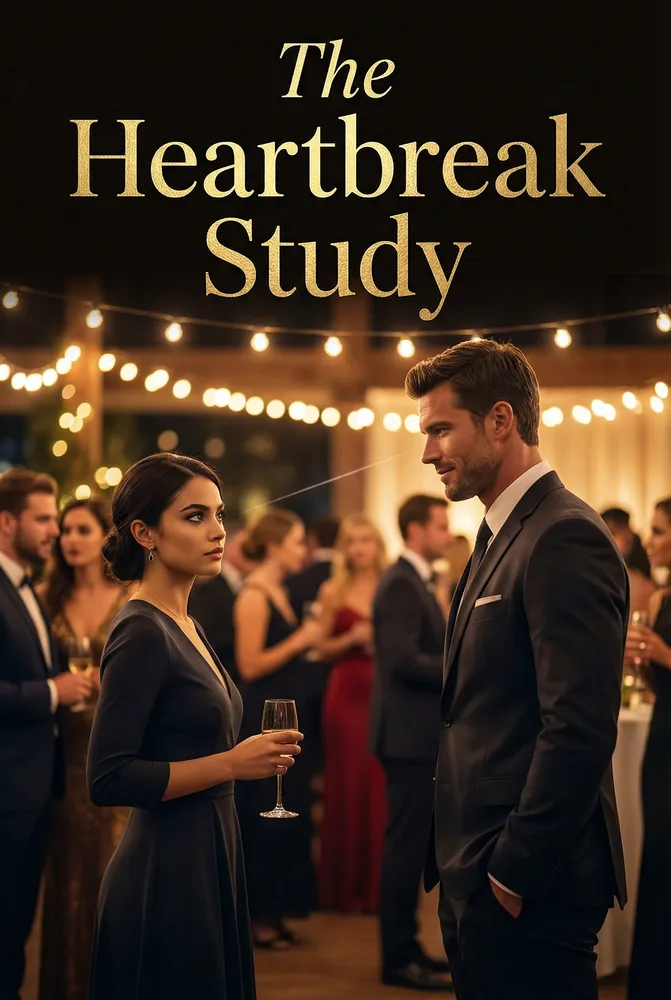
The restaurant is the kind of place where they remember your name and pretend not to notice when you're having a crisis. Julian chose it deliberately—I can tell by the way he's settled into the corner booth like he owns it, which, knowing him, he probably does.
"You look beautiful," he says, and it's not a compliment. It's a statement of fact delivered like a threat, like beauty is something I should be held accountable for.
I'm wearing a black dress that costs more than most people's rent, cut to show the surgical scar on my collarbone. A deliberate choice. A reminder to myself that I survived worse than whatever this is.
"You look expensive," I counter, because accepting compliments feels like surrendering ground I can't afford to lose.
The wine arrives—something French that probably has a pedigree longer than most royal families. Julian orders without consulting me, which should irritate me more than it does. The fact that he orders exactly what I would have chosen is somehow worse.
"We need to talk about something that isn't business," he says once the sommelier has retreated to whatever shadowy corner they hide in.
My spine straightens. My hand finds the stem of my wine glass like it's a weapon.
"If you're about to tell me you have feelings, I should warn you that I don't do feelings. I do transactions. Clean exchanges of value with clearly defined parameters and exit strategies."
"I researched you."
The wine glass pauses halfway to my lips.
"Extensively," he continues, and there's something in his voice—not apology exactly, but acknowledgment. "Before I let myself want you, I needed to understand who you were."
The restaurant suddenly feels too small. The ambient noise—the careful murmur of other diners, the clink of silverware, the soft jazz bleeding through hidden speakers—becomes deafening.
"That's called stalking, Julian. In most jurisdictions, it's illegal."
"I know about the marriage." His eyes don't flinch from mine. "I know about what he did to you. I know about the night you left with a duffel bag and three thousand dollars in cash, and I know about the restraining order you had to fight for in court because he had better lawyers."
My hand trembles.
I set the glass down before he can see it.
"Stop," I say quietly.
"I know about the apartment in Queens where you taught yourself to code at 3 AM because you were too afraid to sleep. I know about the first client you landed—a small financial firm that paid you fifteen thousand dollars to secure their system. I know you cried in your car for an hour after that first deposit cleared because you finally believed you might survive this."
"Julian, I'm warning you—"
"I know about the scar on your collarbone because I asked my security team to find every medical record they could access. I know he threw you against a wall when you told him you wouldn't marry him. I know you wore that dress tonight specifically to show me, to prove you're not ashamed of what happened to you."
The fury rises like something alive.
I stand, gathering my purse with movements sharp enough to draw blood from the air itself.
"You had no right. That information was mine. My trauma, my survival, my scars—those belong to me. You don't get to collect them like data points in your little psychological profile of Scarlett Hayes. You don't get to—"
"Sit down," he says.
Not a request.
Not quite a command either, but something in between that makes my body obey before my mind catches up.
I sit.
"You're right," he continues, and the admission seems to cost him something. "I had no right. What I did was invasive and controlling and exactly the kind of behavior that should make you walk out of this restaurant and never speak to me again."
"Then why are you telling me?"
"Because I'm tired of lying. Because you deserve to know exactly how obsessed I am with you, and because honesty is the only currency I have that might be worth something to you."
He leans forward, and the scent of him—cedarwood and leather and something darker underneath—invades my space like a confession.
"I lost my sister when I was twenty-four," he says quietly. "Her name was Eleanor. She was brilliant and kind and completely incapable of seeing the worst in people. She was dating someone—a man everyone liked. Charming. Successful. The kind of man who looks good in photographs."
I don't move.
"He was also a sadist. By the time I found out what he was doing to her, she was already planning to leave him. She was going to escape, start over. She had a plan."
His jaw tightens.
"He didn't let her leave. He killed her instead. Made it look like a suicide, and it took three years and a small fortune in legal fees to prove otherwise. Three years of watching my parents believe their daughter had chosen to end her own life rather than stay with us."
The fury drains out of me like someone pulled a plug.
"Julian—"
"Since then, I've been trying to control everything. Every variable, every risk, every person in my sphere. I build empires because empires can be fortified. I acquire companies and properties and security systems because I can protect things I own. And when I met you, when I understood what you'd survived and how you'd rebuilt yourself from nothing, I became obsessed with the idea of protecting you."
He reaches across the table, stops just short of touching my hand.
"So I researched you. Not because I didn't trust you, but because I needed to understand the shape of your wounds so I could figure out how to keep them from opening again. It was controlling and invasive and completely fucked up, and I'm telling you anyway because you need to know exactly what you're dealing with."
I stare at his hand, hovering in the space between us.
"You're comparing yourself to him," I say flatly. "Your sister's abuser. You're equating research with violence."
"No." His voice hardens. "I'm acknowledging that I have the same pathology he did—the need to control, the belief that I know better, the certainty that I can protect people from themselves. The difference is that I'm aware of it, and I'm choosing to tell you instead of hiding it."
"That's not actually a difference. That's just self-awareness as a justification for bad behavior."
"You're right."
The agreement catches me off-guard.
"I'm absolutely right, and you need to understand that I didn't survive eight years of building my own life just to hand control over to someone else. I don't care if you have good intentions or trauma-driven motivations. I don't care if you researched me because you wanted to protect me. What matters is that you violated my privacy, my autonomy, my right to be an unknown quantity to you."
"I know."
"And now you're telling me about your sister, which is clearly supposed to make me sympathize with your trauma and overlook the fact that you're a controlling asshole with unlimited resources and no healthy boundaries."
"Yes," he says simply. "That's exactly what I'm doing."
The honesty is somehow worse than a denial would have been.
"You're supposed to fight back," I tell him. "You're supposed to defend yourself or apologize or something. You're not supposed to just... agree with me."
"Would it help if I did?"
"No." I pick up my wine glass and drink the entire thing without tasting it. "It would actually be worse. At least if you fought back, I could justify walking away. But you're just sitting there acknowledging how fucked up you are, and I'm supposed to what—forgive you? Understand you? Fall into bed with you because we both have trauma?"
"I'm sitting here," he says carefully, "acknowledging that I'm fucked up and hoping that maybe, despite that, you might decide I'm worth the risk."
The restaurant tilts.
"That's not fair."
"I know."
"You're weaponizing your vulnerability."
"Yes."
"Stop agreeing with me."
"I can't." He finally touches my hand, his fingers brushing across my wrist where my pulse is doing things I can't control. "Because you're right about everything, and I'm running out of ways to convince you that I'm worth the risk of letting me close."
The warmth of his skin against mine sends a shock of electricity up my arm that I feel in places I've spent eight years trying not to feel anything.
"This is manipulation," I say, but my hand doesn't pull away.
"It absolutely is."
"I should leave."
"You should."
"I'm going to leave."
"Okay."
But I don't leave.
Instead, I sit there with his hand on my wrist, feeling the steady thrum of his pulse against my skin, and realize with something approaching horror that I'm not angry anymore. The fury has transmuted into something else—something that looks a lot like understanding, and understanding is infinitely more dangerous.
"Tell me about Eleanor," I hear myself say.
So he does.
He tells me about a girl who loved terrible poetry and rescue dogs and had dreams of being a social worker. He tells me about the day he realized what was happening, the moment he understood that his sister was trapped with someone who was slowly erasing her. He tells me about the trial, the evidence, the way his parents aged a decade in the span of three years.
And I listen, my hand still under his, feeling the way his pulse accelerates when he talks about the things he couldn't prevent, the ways he failed to save her.
"I couldn't control it," he says finally. "I tried—God, I tried so hard. But I couldn't make her see what he was. Couldn't make her leave. Couldn't protect her from the one person who was supposed to love her."
"So now you try to control everything else."
"Now I try to control everything else," he agrees.
The food arrives, and we eat in silence for a while. The kind of silence that doesn't require filling, that sits between us like a third presence at the table. My hand has returned to my lap, but I can still feel the phantom warmth of his touch, the way his skin felt against mine.
"I'm not going to forgive you for the research," I tell him between bites of something that probably costs more than it should.
"I don't expect you to."
"And I'm not going to promise that I'll let you close just because you have a tragic backstory."
"I wouldn't want you to."
"But I'm also not going to pretend that knowing about Eleanor doesn't change something."
He sets down his fork, gives me his full attention.
"What changed?"
"I understand now why you're the way you are. The control, the obsession with security, the need to know everything about everyone in your sphere. It's not malice. It's fear."
"That doesn't make it okay."
"No," I agree. "But it makes it comprehensible. It makes you human instead of just a very expensive predator."
"Should I be flattered by that assessment?"
"You should be terrified," I say, and I'm not entirely joking. "Because understanding you is more dangerous than being angry at you. Anger I can compartmentalize. Understanding requires empathy, and empathy is how people get hurt."
He reaches across the table again, and this time I don't pull away when his fingers find the inside of my wrist, tracing the sensitive skin there.
"I'm not going to hurt you," he says.
"Everyone hurts everyone eventually. It's not malicious; it's just the cost of proximity."
"Then let me pay it."
The words sit between us, heavy with implication.
"You don't understand what you're asking for," I tell him.
"Maybe not. But I'm asking anyway."
The restaurant has faded to background noise. There's nothing but the feeling of his fingers on my wrist, the scent of cedarwood and leather, the terrible recognition that I want to let him close in ways that have nothing to do with logic and everything to do with the parts of me that have been locked away since I was twenty-three years old.
"I'm not a project," I say quietly.
"I know."
"I'm not a woman who needs saving."
"I know."
"I'm not going to let you control me, no matter how good your intentions are."
"I know."
"Then why are you still here?"
He leans across the table, close enough that I can feel the heat radiating from his body, close enough that his next words are nearly a whisper.
"Because you're the first person I've met who understands what it's like to survive something that was supposed to destroy you. Because when I look at you, I see someone who's built a fortress out of her own strength, and I want to know what it feels like to be let inside. Because I'm tired of being alone in my own neuroses, and you're the only person who might understand them without trying to fix me."
"That's not love," I say. "That's recognition. That's seeing yourself in someone else and calling it connection."
"Maybe. But it's honest, and it's real, and it's the best I can offer you."
He's close enough to kiss now, close enough that I can see the exact shade of grey in his eyes—storm-cloud dark with lightning underneath. Close enough that my pulse has forgotten how to be steady.
I should pull away.
I should stand up and walk out and never look back, because letting him close is the exact opposite of what I've spent eight years building toward.
But instead, I lean forward.
Just barely. Just enough to close the distance between us until there's barely any space left to breathe.
"If you hurt me," I whisper, "I will burn your entire empire to the ground. I will destroy you in ways that will make your competitors look like amateurs."
"I believe you."
"I'm not kidding."
"Neither am I."
And then his mouth is on mine, and it's not gentle or romantic or any of the things I expected. It's desperate and consuming and tastes like wine and cedar and the terrible recognition that I've already let him closer than I intended.
His hand moves from my wrist to the back of my neck, pulling me forward, and I let him because fighting it would require more strength than I currently possess. The kiss deepens, and I feel it everywhere—in my chest, in my stomach, in the places I've spent eight years keeping locked up.
This is a mistake, some rational part of my brain insists.
This is the worst possible decision, another voice agrees.
But underneath both of those thoughts is something louder, something that sounds like finally, like recognition, like the moment right before falling when you're still convinced you might be able to fly.
I pull away first, because I have to, because if I don't, I'm not sure I'll be able to remember why this is dangerous.
His forehead touches mine, and we're both breathing hard.
"I'm still angry at you," I say.
"I know."
"I'm still going to maintain my boundaries and my autonomy and my right to walk away at any moment."
"I know."
"And I'm definitely not forgiving the research."
"I wouldn't expect anything less."
I pull back far enough to look at him properly, to see the intensity in his eyes and understand that this man is going to be the most dangerous thing that's ever happened to me.
Not because he'll hurt me physically.
But because he might be the one person I can't protect myself against, the one variable I can't control or compartmentalize or strategize around.
He's the ghost of every wound I've spent eight years trying to survive, and somehow, impossibly, he's also the answer to a question I've been too terrified to ask.
"We should eat," I say finally.
"We should."
But neither of us moves.
We sit there in the corner booth of an expensive restaurant, with his hand still on the back of my neck and my defenses crumbling like they were never really made of anything solid, and I realize with absolute certainty that I'm completely, utterly fucked.
My phone buzzes.
A text from Iris: How's the "business dinner"? 😏
I ignore it.
Julian's phone buzzes next.
He ignores it too.
And then, from somewhere in the depths of my purse, a second phone—the burner I keep for emergencies only—vibrates with an unknown number.
When I check it, there's a single message:
Hello, Scarlett. I've been looking for you. We have so much to catch up on.
The signature is a name I haven't seen in eight years.
A name that belongs to someone I spent the last decade trying to forget.
Dominic.