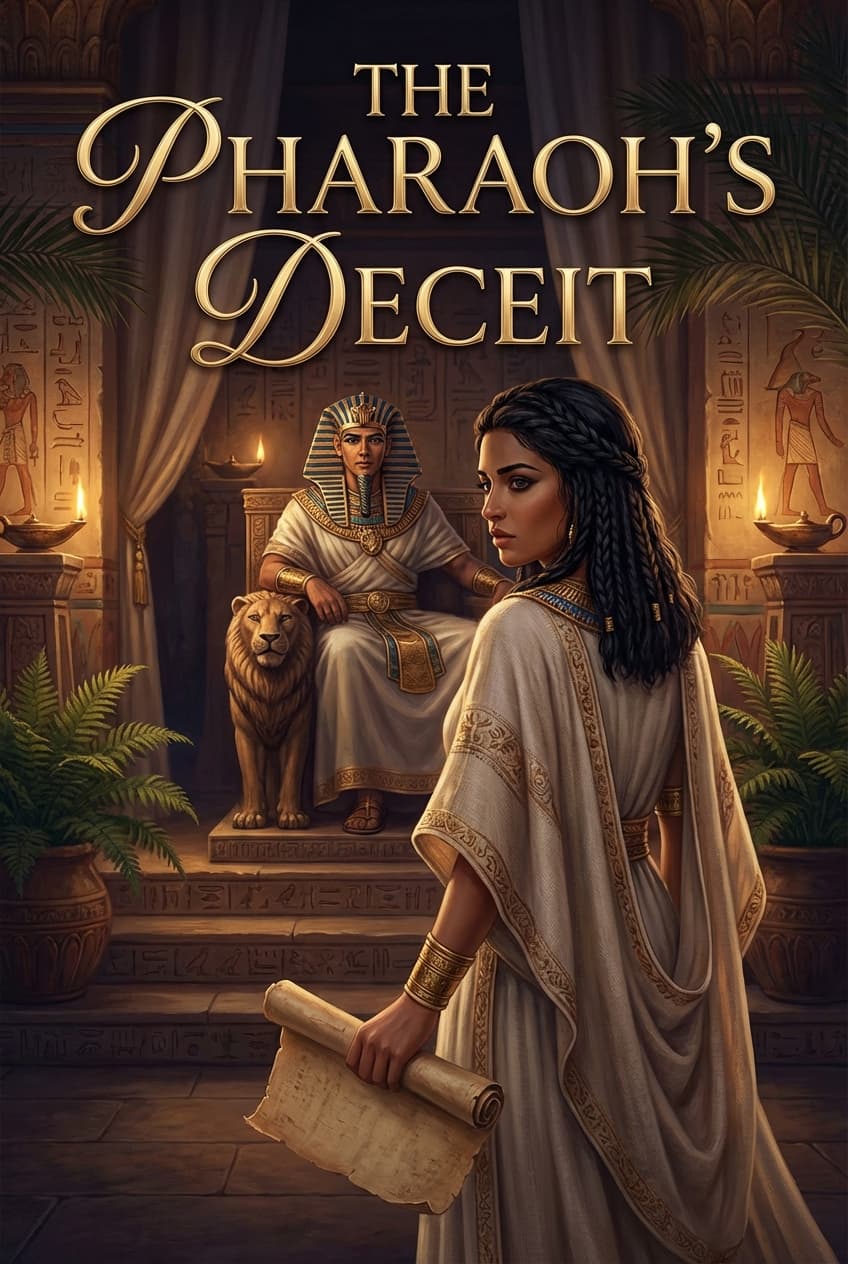
The morning after the garden felt like walking through broken glass.
Every step toward the throne room. Every breath. Every heartbeat that reminded me I was still capable of feeling something beyond survival instinct.
I'd survived the night by not thinking. By focusing on the immediate: wash my face, braid my hair, dress in the modest robes of a useful scholar. By the time dawn broke over the Nile, I'd almost convinced myself I could do this. Could face him as if his mouth hadn't been on mine, as if I hadn't felt the full weight of his loneliness pressed against my own.
Almost.
The palace was already alive with morning rituals. Servants hurried past with linens and offerings. Priests performed their endless ablutions. The scent of frankincense drifted from the temple complex, making my stomach turn.
I made it three corridors before I saw Neferet.
She stood in a shaft of morning light, elegant as always, her kohl-lined eyes tracking me with predatory precision. The lotus perfume she wore was subtle, expensive. Everything about her screamed old bloodline, real power.
"You look unwell," she said. Not a question. An observation.
"I didn't sleep."
"Few do, in this place." She moved closer, studying my face. "The Persian correspondence kept you late?"
The lie would have been easy. Should have been easy. But something in her expression—not quite sympathy, not quite warning—made me hesitate.
"Among other things."
Her lips curved. "My brother has that effect. Keeping people awake."
I felt heat crawl up my neck. "I don't—"
"Please." She waved a hand, dismissive. "I've watched him circle you for weeks like a man starving. And you..." Her eyes narrowed. "You look at him like you can't decide whether to run toward him or away."
My throat closed. "I'm a scholar. Nothing more."
"No," Neferet said softly. "You're not. But whatever you are, Kallista of Rhodes, decide quickly. Before someone else decides for you."
She swept past, leaving me in the corridor with the frankincense and the weight of her words.
Before someone else decides for you.
---
I made it to my chambers before the merchant found me.
He was Greek, which should have been my first warning. But the palace saw enough foreign traders that I didn't think twice when he appeared in the courtyard garden where I'd gone to steady my nerves.
"Kallista." My name in his mouth was wrong. Too familiar. "A moment?"
Everything in me went cold.
He was middle-aged, unremarkable, the kind of face that disappeared in a crowd. Perfect for a courier. He carried a basket of dates and figs, the kind of gift a merchant might bring to curry favor with palace scholars.
And tucked beneath the fruit, I knew, would be the message.
"I don't know you," I said carefully.
"No." His smile didn't reach his eyes. "But we have mutual friends. In Athens."
Athens. Where the coalition had hired me. Where men in marble halls had paid gold for my linguistic gifts and my willingness to sell them.
Where they thought they owned me.
"I'm working," I said. "The Pharaoh's correspondence—"
"Has yielded nothing useful in three months." His voice was pleasant. Conversational. Like we were discussing the weather. "Our friends are beginning to wonder if their investment was wise."
The threat was delicate. Precise. Exactly the kind of blade I'd expect from Athenian politicians.
"I've sent reports," I said. "The trade negotiations, the Persian tensions—"
"Public information." He set the basket down on a stone bench. "We need more. Troop movements. Military strategy. The Pharaoh's true intentions toward the northern territories."
"That's not what we agreed."
"Agreements change." He met my eyes. "You have five days to deliver actionable intelligence. Real intelligence. Or our friends will be forced to reconsider the arrangement."
My mouth went dry. "Reconsider how?"
"The Egyptian court might find it interesting to learn they harbor a Greek spy." He smiled. "Pharaohs are notoriously unkind to traitors. Even beautiful ones."
He left the basket. Left me standing in the garden with the scent of overripe figs and my own rising panic.
Five days.
---
I spent the afternoon in my chambers, staring at blank papyrus.
The message needed to be carefully worded. Valuable enough to satisfy Athens. Vague enough to avoid real damage. True enough to verify if they checked.
The problem was, I'd already given them everything that fit those criteria.
Three months of walking the razor's edge between useful and harmless. Three months of sending just enough intelligence to keep them satisfied while telling myself I wasn't really betraying anyone. That selling public information wasn't the same as true espionage.
That I was still, somehow, a person with principles.
But Athens wanted more. And if I didn't give it to them, they'd expose me.
And Khemweset would know exactly what I was.
My hands were shaking when I finally picked up the reed pen.
I could fabricate something. Invent troop movements that didn't exist, plans that were pure fiction. But if Athens acted on false intelligence and it went badly, they'd know I'd lied. And the consequences would be the same.
I could refuse. Tell them to expose me and be damned. Face Khemweset's judgment and whatever execution method Egypt reserved for foreign spies.
The thought of his face when he learned the truth made me want to vomit.
Or I could give them something real.
My chest felt too tight. The walls too close. I set down the pen and pressed my palms against my eyes, trying to think past the rising panic.
What did I know that Athens would value? What secrets had I learned in three months of translating correspondence, sitting in on trade negotiations, listening to court gossip?
Too much. Far too much.
Khemweset's concerns about the Nubian border. His strategy for handling the Persian ambassador. His private doubts about which advisors to trust. The things he'd said in the garden, alone in the moonlight, when he'd forgotten I was anything but a woman who understood loneliness.
I wanted him back.
The memory of my own words tasted like ash.
---
In the end, I chose the coward's path.
Khemweset had mentioned, weeks ago, that he planned to increase patrols along the eastern trade routes. Not a military campaign. Just a show of force to discourage bandits and remind the Bedouin tribes that Egypt's reach was long.
He'd mentioned it in front of half the court. Public enough that Athens could verify it through other sources. Real enough to seem valuable.
Harmless enough that I could pretend it wasn't truly betrayal.
I wrote it out in the agreed-upon code. Kept the language vague. Made it sound more significant than it was without actually lying.
The whole time, my hands shook.
I sealed the message inside a hollowed date from the merchant's basket. The system was elegant, untraceable. I'd leave the basket in the market tomorrow, and someone would collect it. Simple. Clean.
Except nothing about this was clean.
I sat there holding the date, feeling its weight in my palm.
This was what I'd agreed to. What I'd been paid for. The bargain I'd made to survive after Rhodes fell and left me with nothing but languages and desperation.
I was good at survival. I'd proven that.
But somewhere between Athens and Alexandria, between the throne room and the garden, between duty and the taste of myrrh and cedar on a pharaoh's lips—
I'd stopped wanting to just survive.
I wanted to be someone worth saving.
The date went into the basket. Tomorrow, I'd leave it in the market.
Tonight, I'd try not to think about the price of staying alive.
---
The interception happened faster than I'd expected.
I'd barely made it to the market the next morning when I felt eyes on me. The particular weight of being watched by someone who knew exactly what to look for.
I left the basket at the agreed location—a spice merchant's stall, tucked behind sacks of cardamom and cinnamon. Turned to leave.
And found Ptahmose's creature blocking my path.
He was young, this one. Shaved head, priest's robes, eyes like a snake's. One of the High Priest's endless network of temple servants who moved through the palace seeing everything, reporting everything.
"The High Priest requests your presence," he said. "Immediately."
My blood went cold. "I have work—"
"Immediately."
---
Ptahmose's chambers were in the temple complex, far enough from the palace proper to feel like a different world. The air was thick with frankincense and something else. Something that made my skin crawl.
Power. Old power. The kind that predated pharaohs and would outlast them.
He was waiting in a room lined with scrolls and religious artifacts. The leopard skin of his office draped across his shoulders. His amber eyes tracked me like prey.
"Kallista of Rhodes." He smiled. "Please, sit."
I remained standing. "I was told this was urgent."
"It is." He gestured to a low table. "I have something that belongs to you."
My heart stopped.
On the table, split open, was the date I'd left in the market.
And beside it, the decoded message. My handwriting. My intelligence. My betrayal laid bare.
"Where did you—"
"I have eyes everywhere, child." Ptahmose's voice was soft. Gentle. Like a priest comforting the dying. "Did you truly think you could move through this palace unseen? That your little games with Greek merchants would go unnoticed?"
I couldn't breathe. Couldn't think past the roaring in my ears.
"The question," he continued, "is what to do with this information. The Pharaoh would be... displeased... to learn his trusted scholar is a foreign spy."
"I haven't—" My voice broke. "That message was nothing. Public information. Nothing that could harm—"
"Egypt?" He laughed. "Perhaps not. But the fact of your betrayal..." He picked up the papyrus delicately. "That would harm you considerably. I imagine Pharaoh Khemweset would take such deception quite personally."
The room spun. I grabbed the edge of the table to steady myself.
"What do you want?"
"Ah." His smile widened. "Now we come to it."
He stood, moving around the table with the slow grace of a predator. The frankincense scent grew stronger, choking.
"I want what Athens wants," he said. "Real intelligence. The Pharaoh's military plans. His strategies for the northern territories. His private thoughts on which advisors to trust, which to eliminate."
"I don't have access to—"
"You have his ear." Ptahmose's eyes glittered. "And apparently, more than that. The whole palace whispers about how he watches you. How he keeps you close. How he looks at you like a man starving."
Heat flooded my face. "That's not—"
"Get closer." His voice cut like a blade. "Make him trust you. Make him need you. And bring me what I ask for. Or I will take this evidence to him myself and watch while he decides your fate."
I was shaking. Full-body tremors I couldn't control.
"You're asking me to truly betray him."
"I'm asking you to survive." Ptahmose set the papyrus down. "Which you seem quite skilled at. Rhodes burned, and here you stand. Your city fell, and you found new masters. The Pharaoh is simply another man who can be used."
"He's not—"
"He's a king." The words were final. Absolute. "And kings are tools, child. Tools for those wise enough to wield them."
He moved to the door, dismissing me with the casual arrogance of someone who knew they'd won.
"You have three days to bring me something useful. Military deployments. Strategic plans. His private correspondence with the generals." He paused. "Or I tell him what you are. Your choice."
The door closed behind him with a soft click.
I stood there in the frankincense and the silence, holding the edge of the table like it was the only solid thing left in the world.
Three days.
Three days to choose between betraying Khemweset or condemning myself.
Three days to decide if survival was worth the price of my soul.
I looked down at the decoded message, my own handwriting stark against the papyrus.
The Pharaoh plans increased patrols along eastern trade routes.
Such a small thing. Such a harmless thing.
The first step down a path I could never walk back from.
My legs gave out. I sank to the floor, back against the wall, and let myself feel the full weight of what I'd become.
Not a scholar. Not a survivor.
A traitor.
And the worst part—the part that made bile rise in my throat—was that I'd done this to myself. Every choice, every compromise, every bargain made in the name of survival had led here. To this room. This moment. This impossible choice.
I'd told myself I still had principles. That I was more than a spy. That somewhere beneath the lies and the deception, I was still Kallista of Rhodes, the scholar who'd loved languages and learning and truth.
But Rhodes was ash. And I was what I'd made myself.
The only question left was how far I'd fall before I hit bottom.
I pulled myself up. Smoothed my robes. Wiped my face.
Three days.
I'd survived worse. I'd survive this.
Even if surviving meant becoming something I'd never be able to forgive.
The walk back to the palace felt like a funeral march. My funeral. The death of whatever illusion I'd clung to about being a good person trapped in bad circumstances.
I wasn't trapped.
I'd walked into this cage willingly. Locked it behind me. Swallowed the key.
And now Ptahmose held the only way out.
Somewhere in the palace, Khemweset was holding court. Making decisions that would shape kingdoms. Carrying the weight of the Two Lands on shoulders that had learned too young how heavy a crown could be.
Trusting me.
Wanting me.
Looking at me like I might be someone who could understand the loneliness of absolute power.
I pressed my hand against my mouth to keep from screaming.
Three days to steal his secrets.
Or three days until he learned mine.
Either way, I was going to lose him.
And somehow—impossibly, stupidly—that hurt worse than anything else.