The carriage rocks beneath me like a cradle designed by someone who hates comfort, and I'm drowning in silk and resignation.
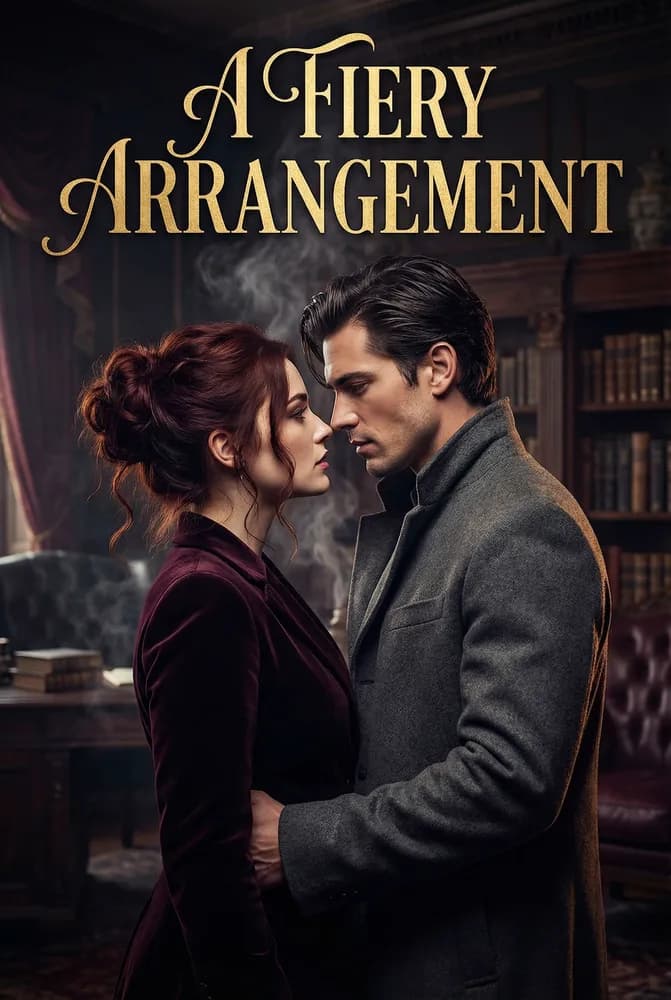
My gown—ivory with silver threading that probably cost more than a servant's yearly wages—is a masterpiece of constraint. The corset cinches my ribs until breathing feels like a luxury I haven't earned. My hair, dark auburn and utterly uncooperative, has been pinned into submission by a lady's maid who wielded her instruments like she was preparing me for execution rather than a betrothal announcement. Perhaps there's no difference.
I catch my reflection in the carriage window: pale skin, sharp cheekbones, the faint scar along my jawline that Father has never quite forgiven me for acquiring. Eight-year-old Catherine climbing the library shelves for a book on criminal law. Eight-year-old Catherine, already destined to be a pawn, already falling.
The irony isn't lost on me.
"Stop fidgeting," my mother's voice echoes in my memory, though she isn't here. She never is. Mother learned long ago that my father's ambitions don't require her presence—only her bloodline and her silence.
My fingers tap against the emerald silk of my skirts. Once. Twice. Three times before I force them still.
The ball awaits. The Duke's son awaits. The rest of my life, meticulously planned and utterly devoid of choice, awaits.
I've had eight years to accept this.
Eight years since James Harrow died.
The thought arrives unbidden, as it always does when I'm alone with my thoughts and the rhythmic clop of hooves against country road. Eight years since that autumn morning when they dragged his body from the river—or so they said. I never saw him myself. Father wouldn't allow it. "Not appropriate," he'd said, his voice the temperature of a courtroom in winter. "Not necessary. The boy's death is unfortunate but irrelevant to your future."
Unfortunate. As if James were a spilled drink rather than the only person who'd ever looked at me like I was something more than an investment strategy.
I was sixteen when he disappeared. He was seventeen, wild and restless and entirely unsuitable—a fact Father reminded me of with relentless precision. The younger son of a minor baron, with no prospects and less sense. A distraction from my studies in law and consequence. A complication.
Father despises complications.
"You will focus on your education," he'd said, and I had, because I'm very good at duty. I'm very good at being what's expected. I'm very good at swallowing my own desires and pretending I never had them in the first place.
The carriage lurches over a rut in the road, and my head knocks gently against the velvet interior. The emerald necklace at my throat—a betrothal gift from a man I've met exactly twice—catches the lamplight. Cold metal against warmer skin. A collar, really, though nobody would be so crass as to call it that.
The night is thick outside the windows, the kind of darkness that swallows sound. We're on the country road now, the one that cuts through the Blackwood estate. Father chose this route deliberately—it's faster, and speed is important when you're consolidating power. Every minute counts.
Every minute I'm not married is a minute something could go wrong.
I'm so lost in my own beautiful misery that I almost don't hear it.
The crack of a whip. The startled shout of the driver. The carriage lurches violently to the left, and I'm thrown against the window hard enough to rattle my teeth.
"What in God's—" I don't finish the curse because I'm too busy grabbing for the strap to keep myself from sliding across the bench seat.
The carriage stops with a violent jerk that nearly sends me to the floor.
Silence. Thick and suffocating.
Then: "Nobody move, and nobody gets hurt."
The voice comes from outside, rough and commanding, and it sends a spike of something through my chest that feels dangerously close to excitement. How utterly pathetic. I'm about to be robbed, and my body is responding like this is the most interesting thing that's happened to me in years.
Because it probably is.
Footsteps. Multiple sets. Horses. The soft clink of weapons being drawn. This is no amateur operation—whoever these people are, they're organized. Professional. Terrifying in a way that makes my pulse jump into my throat.
I press myself against the back of the bench, my fingers still gripping the strap. The emerald necklace suddenly feels very heavy. Very real. Very much like something someone might kill for.
The carriage door swings open.
A man stands silhouetted against the darkness, and for a moment I can't see his face—just the outline of him, broad-shouldered and tall, the kind of presence that fills space even when he's standing still. He's wearing a mask, black leather that covers the upper half of his face, but I can see his jaw. I can see the stubble shadowing it, the thin scar that runs from temple to—
No.
That's impossible.
"Your jewels, if you please," he says, his voice smooth as oil, and I feel something inside me crack open like an egg.
I know that voice.
I know it the way I know my own heartbeat, the way I know the taste of fear. I know it from whispered conversations in the library, from stolen moments when my father wasn't watching, from eight years of trying very hard to forget it.
My mouth goes dry.
"I said—" he starts, but I'm already moving. Not away from him. Toward him. My hand comes up, and I'm pointing at his masked face with the kind of certainty that usually only comes right before you make a catastrophic mistake.
"James Harrow."
It's not a question.
The world stops.
I can see his entire body go rigid, see the moment he recognizes me in return. His hand—the one holding the gun—drops slightly. Behind him, one of his companions makes a sound of alarm, but James doesn't move. Doesn't speak. Doesn't do anything but stare at me like I've just risen from the dead instead of the other way around.
"That's impossible," he says finally, and his voice has changed. The smooth highwayman's confidence has fractured, revealing something raw underneath. Something that sounds an awful lot like horror.
"Yet here I am," I say. My own voice is steadier than my hands. My fingers are still gripping the strap like it's the only thing keeping me tethered to reality. "Apparently, death isn't as permanent as advertised."
"Catherine—"
"Don't." I don't know why I say it. I don't know why I'm protecting him when I should be screaming, calling for help, doing literally anything except standing here in an expensive gown and an emerald collar, staring at a ghost who's very much alive and very much a criminal.
But I am.
"Don't what?" he asks. There's something dangerous in his voice now, underneath the shock. Something that makes my stomach clench.
"Don't use my name. Don't draw attention. Don't make this worse than it already is." I lower my hand, deliberately. A choice. A small act of rebellion against everything my father has spent eight years building. "We have nothing to say to each other, and you have a robbery to complete. I suggest you do it quickly."
He stares at me for another long moment, and I can feel the weight of his gaze like a physical thing. Like gravity. Like inevitability.
Then he steps into the carriage.
The door closes behind him with a soft click that sounds far too final.
I should be afraid. I absolutely should be afraid. Instead, my heart is racing for reasons that have nothing to do with self-preservation and everything to do with the fact that James Harrow is standing three feet away from me in a space so small that I can smell him—leather and tobacco and something darker underneath, something like cedar and gunpowder and night air, and it's a scent I remember with perfect, devastating clarity.
"You're supposed to be dead," I say quietly.
"You're supposed to be married," he replies, and there's something in his voice that sounds like accusation. Like grief. Like eight years of complicated feelings compressed into a single sentence.
"Not yet," I say. "Give me an hour."
It's a joke. A terrible, inappropriate joke that makes absolutely no sense, and yet I watch his shoulders drop slightly, like something inside him has shifted. Like maybe I've just given him something he didn't know he needed.
The mask is still on. I still can't see his full face. But I can see his hands, and I watch as they clench into fists at his sides.
"Why didn't you scream?" he asks. "Why didn't you call for help?"
I consider lying. I'm very good at lying—eight years of my father's tutelage will do that to you. But something about this moment, this impossible moment, demands truth.
"Because," I say slowly, "you're the first interesting thing that's happened to me in eight years. And I'm not quite ready to let you go."
He makes a sound like a laugh, but it's broken. Fractured. It sounds like a man who's been drowning and just remembered what air tastes like.
"Catherine," he says again, and this time I don't stop him. "What happened to you?"
I could tell him about the betrothal. About my father's plans. About the way I've spent eight years being groomed and polished and prepared for a marriage that was never really mine to refuse. I could tell him about the loneliness, the weight of duty, the constant grinding pressure of being exactly what everyone expects me to be.
Instead, I reach up and touch the edge of his mask.
"That's not a conversation we have time for," I say softly. "And it's certainly not a conversation we have in a carriage during a robbery."
His breath catches. I can hear it. I can feel the tension radiating off him in waves, and for a moment—just a moment—I think he's going to reach for me. I think he's going to pull me close and prove that this is real, that I'm not hallucinating the past eight years into a different shape.
But he doesn't.
Instead, he steps back, and the space between us feels like a chasm.
"The necklace," he says, his voice carefully controlled. "Give it to me."
It's a test. I recognize it immediately. He's asking me to choose: the safe option, the expected response, or something else. Something that acknowledges that everything has changed in the last sixty seconds.
I reach up and unclasp the emerald collar. It falls into my palm, cold and heavy, and for a moment I just hold it. This symbol of my betrothal. This proof that I belong to someone else.
Then I hand it to him.
"There," I say. "Now you have something worth stealing."
He takes it, and our fingers brush.
It's barely a touch—a whisper of contact, accidental and brief—but it sends a shock through my entire body that's almost violent in its intensity. I haven't been touched by anyone in years except servants and my father, and certainly never by anyone who mattered. Certainly never by James.
"Don't move," he says, but his voice is softer now. "Don't scream. Don't do anything stupid."
"I'm already doing something stupid," I tell him. "But I'll do it quietly."
He turns toward the door, and I watch the line of his back, the way his shoulders tense beneath the dark fabric of his coat. He's leaving. Of course he's leaving. He's a highwayman, not a savior. Whatever he was to me eight years ago, he's not that anymore.
He can't be.
"James," I say, and he stops with his hand on the door frame. "Where do I find you?"
He doesn't turn around. "You don't. You forget this happened. You marry your duke's son, and you live the life your father planned for you."
"And if I don't want to?"
Now he does turn. The mask is still on, but I can see his eyes, and they're storm-gray and full of something that looks an awful lot like desperation.
"Then you're even more foolish than I remembered," he says, "and I can't afford to let you be foolish. Not anymore. Not with what I've become."
He slips out of the carriage before I can respond, and I hear him shouting orders to his men. The horses shift nervously. There's the sound of hoofbeats, growing fainter, until the only thing left is silence and the ghost of his scent lingering in the air like a promise or a threat—I can't quite decide which.
The driver, shaken but unharmed, climbs back onto his perch. The carriage lurches forward again, resuming its journey toward the ball, toward my future, toward the life that's been waiting for me like a trap.
I sit alone in the darkness, my fingers still tingling from that accidental touch, and I realize something with perfect, crystalline clarity:
I'm not going to marry the Duke's son.
And I'm not going to let James Harrow disappear again.
Whatever it takes, whatever the cost, I'm going to find him. I'm going to make him see that I'm not the girl he left behind—I'm something far more dangerous now. I'm a woman who knows how to play the game my father taught me, and I'm willing to break every rule to win.
The emerald necklace is gone, stolen by a ghost.
But what he's taken from me is far more valuable.
He's taken my resignation, and he's left me with something I haven't felt in eight years:
Hope.