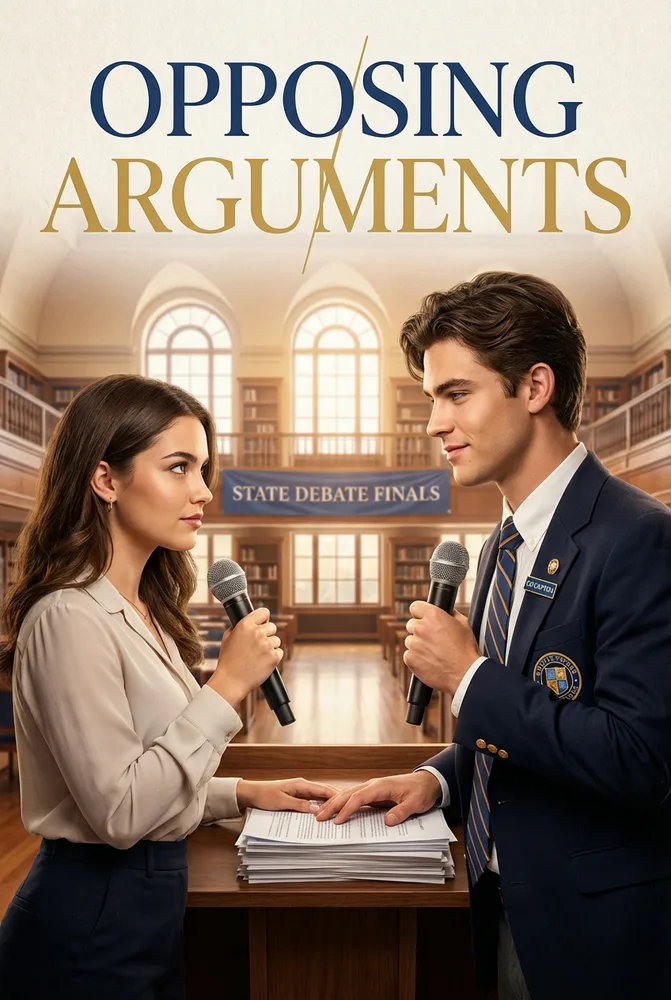
The library at 11 PM smelled like old paper and the desperate anxiety of students who'd procrastinated too long. I'd claimed our usual table in the back corner, armed with enough coffee to fuel a small army and a color-coded study guide that would make even Jordan question my sanity.
Kai arrived exactly on time, looking unfairly good in a paint-stained henley that had definitely cost more than my entire outfit. His hair was disheveled like he'd been running his hands through it, and the shadows under his eyes suggested he'd been sleeping as poorly as I had.
"Hey." His voice was careful, testing the waters between us.
"Hey yourself." I gestured to the chair across from me, maintaining the safe distance of the table. "Ready to cram three weeks of Baroque art into your brain?"
"Sounds painful."
"It will be. I brought flashcards."
He groaned, but he sat down, and for the first hour, we actually managed to keep things professional. I quizzed him on Caravaggio's use of chiaroscuro. He correctly identified the difference between Bernini and Borromini's architectural styles. We maintained appropriate eye contact and didn't mention the messages we'd exchanged, the confessions we'd made.
We were doing so well at pretending.
By midnight, the library had emptied out except for a few desperate souls scattered across the upper floors. Kai was getting punchy, making increasingly absurd mnemonics to remember dates and artist names.
"Rubens painted fleshy people because he was... rubenesque," he announced, looking pleased with himself.
"That's not even remotely helpful for remembering 1577 to 1640."
"Fine. Rubens... really... utterly... believed... eating... never... stopped." He counted on his fingers. "See? The first letters—"
"That doesn't spell anything."
"It spells commitment to the bit." He grinned at me, and God, that smile. It should be illegal at midnight when my defenses were down and we were alone and he smelled like cedar and something warm I couldn't name.
I looked back down at my notes. "Let's move on to Dutch Golden Age."
We pushed through another hour. Then another. The coffee went cold. My eyes started to burn. Kai's annotations in the margins of his textbook became increasingly illegible, his focus wavering.
Around 2 AM, I found him staring at the same page he'd been on for ten minutes.
"Kai."
"Mm?"
"You're not reading."
"I'm absorbing. Through osmosis."
"That's not how learning works."
"Are you sure? Because I feel very absorbed." He closed the textbook and leaned back in his chair, stretching his arms above his head. The henley rode up, exposing a strip of stomach that I absolutely did not stare at.
Liar.
"We should take a break," I admitted, rubbing my eyes. My vision had started to blur around the edges, words swimming on the page.
"Revolutionary idea." He stood, rolling his shoulders. "I'm getting more coffee. Want some?"
"I want it injected directly into my veins."
"So that's a yes."
He disappeared toward the vending machines on the second floor, and I let my head drop onto my folded arms, just for a minute. Just to rest my eyes.
When I looked up, Kai was setting two steaming cups on the table—real coffee from the 24-hour café across the street, not the sludge from the vending machine.
"You left the library?"
"You looked like you needed the good stuff." He slid one cup toward me. "Fair warning: I told them to make it strong enough to wake the dead."
I took a sip. It was perfect—hot and bitter and exactly what I needed. "You didn't have to do that."
"I know."
Something in his voice made me look up. He was watching me with an expression I couldn't quite read, soft around the edges in a way that made my chest tight.
"What?"
"Nothing. Just..." He shook his head. "You've been here for four hours helping me not fail, and you look at a decent cup of coffee like I gave you the world."
"It's really good coffee."
"Mira."
The way he said my name. Like it mattered. Like I mattered.
I looked away, uncomfortable with the tenderness in his gaze. "We should get back to studying."
"Or," he said slowly, "we could acknowledge that we're both exhausted and running on fumes and maybe talk about something that isn't the Council of Trent's impact on Counter-Reformation art."
"The exam is in twelve hours."
"And you've prepared me better than any tutor I've ever had. Which is saying something, because my aunt has hired a lot of tutors." He wrapped his hands around his coffee cup. "I'm not going to absorb anything else tonight. My brain is full."
He wasn't wrong. I could see the fatigue in every line of his body, the way his usual confidence had worn thin. And if I was honest with myself—which I tried not to be, generally—I was running on empty too.
"Fine," I conceded. "Fifteen-minute break."
"Wow. A whole fifteen minutes. You really know how to live dangerously."
"Shut up and drink your coffee."
We sat in silence for a moment, the kind that should have been awkward but somehow wasn't. The library was quiet except for the hum of fluorescent lights and the distant sound of someone's printer jamming on the floor above.
"Can I ask you something?" Kai's voice was careful again, like he was approaching a skittish animal.
"That depends on the question."
"Why do you do this to yourself?"
I looked up sharply. "Do what?"
"This." He gestured at the color-coded notes, the highlighted textbooks, the empty coffee cups scattered across the table. "You're not even the one taking the exam, and you've worked harder on this than I have. You do it with everything—I've seen you in the library at 6 AM, still here at midnight. Jordan mentioned you pulled three all-nighters last week for a paper that wasn't due for another month."
"Jordan talks too much."
"Jordan worries about you." He leaned forward, elbows on the table. "So do I."
"You barely know me."
"I know you treat every assignment like your life depends on it. I know you haven't taken a real break since the semester started. I know you're running yourself into the ground, and I can't figure out if you don't notice or don't care."
The observation hit too close to home. I wrapped my hands around my coffee cup, feeling the heat seep into my perpetually cold fingers.
"My parents didn't come to this country so I could be mediocre," I heard myself say. The words came out harder than I intended. "They worked shit jobs for twenty years so I could have opportunities they never had. My mom cleans houses. My dad works overnight shifts at a warehouse. They're exhausted all the time, and they never complain, because they're doing it for me."
Kai was quiet, listening.
"So yeah, I work hard. Because anything less than perfect feels like I'm throwing their sacrifice back in their faces." I stared into my coffee. "Every B feels like proof I don't deserve to be here. Every mistake is confirmation that I'm just a girl from nowhere who got lucky, and eventually, someone's going to figure out I don't belong."
"That's a lot of pressure to carry."
"It's reality."
"It's bullshit."
I looked up, surprised by the vehemence in his voice.
"You're here because you earned it," Kai said. "Not because of luck. Not because someone made a mistake. Because you're brilliant and driven and you work harder than anyone I've ever met." His eyes were intense, pinning me in place. "And your parents' sacrifices don't mean you have to be perfect. They mean you have to be happy. That's what parents want—for their kids to have better lives than they did."
"You don't know my parents."
"No, but I know mine." His jaw tightened. "I know what it's like to carry a legacy you didn't ask for. To feel like every choice you make is a referendum on your family name."
I'd been so focused on my own confession that I'd almost forgotten—Kai had his own weight to carry. The Ashford name. The artistic legacy. The very public failure that had sent him running from Westbrook.
"What happened?" I asked softly. "At Westbrook. You don't have to tell me, but..."
He was quiet for so long I thought he wouldn't answer. Then he exhaled, running a hand through his hair.
"There was a showcase. End of sophomore year. The faculty invites gallery owners, critics, collectors. It's a big deal—can make or break your career before it even starts." His fingers drummed against his coffee cup. "I'd been working on this series for months. Poured everything into it. My professor called it ambitious. Innovative. Said I was going to make a name for myself."
The past tense hung heavy in the air.
"The night of the showcase, this critic—someone my aunt had specifically invited—spent twenty minutes in front of my work. Twenty minutes. I thought that was good, you know? That he was really seeing it." Kai's laugh was bitter. "Turns out he was cataloging everything wrong with it. His review came out the next day. Called my work 'derivative drivel from a trust fund baby coasting on his family name.' Said I had technical skill but no soul. That I was 'the artistic equivalent of a paint-by-numbers kit.'"
"Jesus."
"The best part? My aunt agreed with him." He looked at me, and the pain in his eyes was raw. "Not publicly, of course. But privately, she said maybe he had a point. That I needed to dig deeper, find my authentic voice. As if I hadn't just bled myself dry trying to do exactly that."
I understood, suddenly, why he'd walked away. Why he treated his talent like something disposable. If you don't try, you can't fail. If you don't care, it can't hurt.
Except it did hurt. I could see it in every line of his body.
"For what it's worth," I said quietly, "I think you're talented. The sketches I've seen in your notebook—they're good. Really good."
"You've been snooping in my notebook?"
"You leave it open on the table. That's basically an invitation."
A small smile tugged at his mouth. "What sketches?"
"The architectural details. The hands. There was one of the library—" I stopped, remembering. "You made it look beautiful. Not like this fluorescent-lit hell we spend all our time in. Like something worth preserving."
He was looking at me strangely.
"What?" I asked.
"You actually looked. At my work. Not because you had to, but because you wanted to."
"They're good," I repeated, feeling suddenly self-conscious. "You shouldn't have stopped."
"I haven't. Not completely." He pulled his notebook from his bag, flipped it open. "I just... I don't show anyone anymore. It's easier that way."
The pages were full of sketches—quick studies of buildings and people, detailed renderings of objects I recognized from around campus. His hand moved across the paper with confidence, creating lines that were both precise and expressive.
"See?" I said. "Talented."
"Or maybe just persistent." He was quiet for a moment, studying a sketch of what looked like the library's main staircase. Then: "Can I draw you?"
The question caught me off guard. "What?"
"Your hands." He gestured to where my fingers were wrapped around my coffee cup. "They're expressive. The way you hold things, the ink stains on your fingers. I've wanted to sketch them for weeks."
"That's..." I didn't know how to finish that sentence. Weird? Flattering? Terrifying?
"You can say no," he added quickly. "I know it's a strange request."
But I didn't want to say no. Despite every instinct screaming that this was dangerous, that letting him look at me that closely would strip away defenses I couldn't afford to lose, I wanted to see myself through his eyes.
"Okay," I whispered.
His face lit up. "Yeah?"
"Just my hands. Nothing else."
"Just your hands," he agreed.
He moved his chair around to my side of the table, close enough that I could smell cedar and bergamot and the faint chemical tang of turpentine that never quite washed out. Close enough that our knees almost touched.
"Keep holding your coffee," he instructed, pulling out a pencil. "Just like that."
I tried to stay still, hyperaware of his gaze on my hands, the scratch of pencil on paper. He worked quietly, with a focus I'd never seen from him during our tutoring sessions. This was different. This was what he loved.
"You're tense," he murmured. "Relax."
"Easy for you to say. You're not being studied like a specimen."
"I'm not studying you. I'm seeing you." His eyes flicked up to meet mine, then back down to the page. "There's a difference."
The intimacy of the moment was almost unbearable. It was 3 AM and we were alone and he was looking at me like I was something worth capturing, worth preserving. Like I mattered beyond my GPA and my color-coded notes and my ability to help him pass his exam.
"Your hands are beautiful," he said quietly, still sketching. "Did you know that?"
"They're just hands."
"They're capable hands. Strong. Look at the ink stains here—" He gestured without touching, but I felt the attention like a physical thing. "Evidence of all those notes you take. And here, this callus from holding pens too tight. You wear your work on your skin."
"That's not beautiful. That's just... damage."
"It's proof you care. Proof you're willing to bleed for what matters to you." He looked up, and the expression in his eyes made my breath catch. "That's beautiful, Mira. Even if you can't see it."
The tenderness in his voice broke something in me. Some wall I'd been maintaining since that first kiss, since his confession over text, since I'd admitted I couldn't stop thinking about him.
"Kai," I whispered.
He set down his pencil. We were so close I could count his eyelashes, see the faint stubble along his jaw, feel the heat radiating from his body.
"We said we'd keep things professional," I managed.
"I know."
"This isn't professional."
"I know."
Neither of us moved. The air between us felt charged, heavy with everything we weren't saying.
"I should go," I said, but I didn't move.
"You should," he agreed, but his hand came up to cup my face, thumb brushing my cheekbone with devastating gentleness.
"This is a bad idea."
"Terrible idea."
"Your aunt will—"
"I don't care." His voice was rough. "I'm so tired of caring what she thinks. What anyone thinks."
"Kai—"
He kissed me.
Not like the first time, desperate and impulsive and over before I could process it. This was slow. Deliberate. A question and an answer all at once.
I kissed him back, threading my fingers through his hair, pulling him closer. He tasted like coffee and something sweet, and his hands were careful on my face like I was something precious, something that might break.
But I wasn't breaking. For once, I felt whole.
He pulled back just enough to rest his forehead against mine, both of us breathing hard.
"We can't do this," I whispered against his mouth.
"I know."
"Your aunt—"
"I know."
"My scholarship—"
"I know." His hand slid to the back of my neck, fingers tangling in my hair. "I know all the reasons this is a bad idea. I've been listing them for weeks. But right now, I don't care about any of them. Right now, all I care about is you."
I should have been strong. Should have pulled away, grabbed my things, maintained the boundaries we'd agreed on.
Instead, I kissed him again.
This time was different—hungrier, more urgent. His hands slid down my back, pulling me closer until there was no space between us. I made a sound I'd probably be embarrassed about later, but right now I didn't care. Right now, all I wanted was more of this, more of him, more of the way he made me feel like I was something other than a collection of achievements and anxieties.
When we finally broke apart, we were both shaking.
"I should go," I said again, and this time I meant it. If I stayed any longer, I'd do something reckless. Something I couldn't take back.
"I know." But his hand lingered on my face, thumb tracing my bottom lip.
I forced myself to stand, to gather my notes and books with trembling hands. My lips felt swollen, my skin flushed. I probably looked thoroughly kissed, and I didn't care.
"The exam," I managed. "You should get some sleep. A few hours at least."
"Mira."
I looked back at him. He was still sitting there, hair disheveled from my fingers, eyes dark and intense.
"Thank you," he said. "For tonight. For all of it."
"You're going to pass," I told him. "You know this material. You just have to trust yourself."
"I meant thank you for this." He gestured between us. "For being honest. For not running."
"Who says I'm not running?"
"You're still here, aren't you?"
He had a point.
I shouldered my bag, trying to find some semblance of composure. "Text me after the exam. Let me know how it goes."
"I will."
I made it halfway to the door before his voice stopped me.
"Mira?"
I turned.
He was holding up his sketch—my hands wrapped around a coffee cup, rendered in quick, confident lines that somehow captured not just the physical reality but something essential I'd never seen in myself.
"You can have this," he said. "If you want it."
I walked back, took the paper from his hands. Our fingers brushed, and even that small contact sent electricity up my arm.
"It's beautiful," I whispered.
"So are you."
I left before I could do something stupid like kiss him again. Before I could forget all the reasons this was dangerous, all the ways it could destroy everything I'd worked for.
But as I walked out into the cold pre-dawn air, the sketch clutched carefully in my hands, I couldn't bring myself to regret what had happened.
For once in my carefully controlled life, I'd done something just because I wanted to.
And it had felt like flying.
My phone buzzed as I crossed the quad.
I can't stop thinking about how you taste like vanilla and coffee.
Then:
This is going to be a problem, isn't it?
I looked up at the sky, at the stars fading as dawn approached, and typed back:
The biggest problem.
A pause. Then:
Worth it though.
I slipped my phone into my pocket, the sketch safe in my bag, and let myself smile.
Tomorrow, Kai would take his exam. Tomorrow, we'd face whatever consequences came from crossing lines we'd promised not to cross. Tomorrow, reality would reassert itself with all its complications and impossibilities.
But tonight—this morning—I was going to hold onto the feeling of his hands on my face, his mouth on mine, his voice calling me beautiful like he meant it.
Tonight, I was going to let myself want something that wasn't on any syllabus or study guide.
And if that made me reckless, if that made me foolish, if that made me exactly the kind of distracted, unprofessional disaster Victoria Ashford would use against me—
Well.
Some mistakes were worth making.